
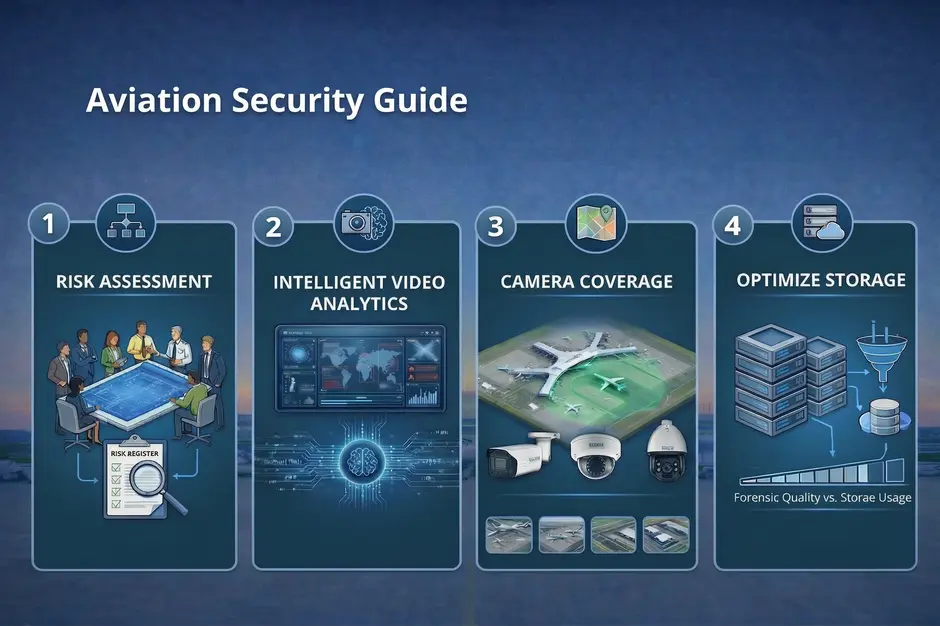
Rapid growth in Indian and global air traffic through 2026 is intensifying pressure on airport infrastructure, making robust aviation security considerations non‑negotiable. Security leaders need a clear, step by step aviation security guide that aligns physical protection with airline data protection and compliance expectations.
This article outlines three practical levers for how to improve airport security measures within a structured aviation risk assessment process:
- Intelligent video analytics
- Cameras with a wider field of view
- Strategic storage optimization
Matrix supports these priorities as an integrated, enterprise‑grade security partner for modern, expansion‑ready airports.
Step 1: Conduct an Aviation Risk Assessment to Define Surveillance Objectives
A disciplined aviation risk assessment process is the foundation of all aviation security considerations. Before selecting cameras or analytics, convene key stakeholders: airport authority, airline security teams, IT and network owners, compliance officers, operations leaders, and local law enforcement partners.
Together, catalogue realistic threat scenarios, including insider misuse, perimeter breaches, unauthorized access to restricted zones, tampering with critical infrastructure, data theft, and compliance failures around evidence handling. Rank these risks by likelihood and impact, then align them with clear surveillance outcomes.
Translate each risk into objectives such as early detection, visible deterrence, post‑incident investigation support, and improved operational efficiency. Link these to airline data protection and compliance expectations, covering video retention periods, access control to recordings, and secure sharing with authorities.
Document measurable goals that will steer technology choices, for example:
- Reducing blind spots in airside and terminal areas
- Shortening incident response and investigation times
- Lowering storage cost without losing critical evidence
Translate Risks into Surveillance Requirements
Use your risk register to define where cameras are essential, what behaviours they must detect, and which alerts operators need. Classify areas into:
- Public zones (check‑in, arrivals, parking)
- Restricted zones (baggage handling, boarding gates)
- Critical infrastructure (runways, fuel farms, power rooms)
- Data centers and network rooms
Assign stricter surveillance rules to higher‑risk zones, preparing the ground for tailored analytics, field‑of‑view planning, and storage configurations in subsequent steps.
Step 2: Implement Intelligent Video Analytics for Proactive Security
Transforming CCTV from a passive recorder into an active sensor network is central to modern aviation security considerations. Instead of relying on operators to spot every risk, intelligent analytics continuously scan video feeds, trigger alerts, and document events.
Prioritize analytics that directly support how to improve airport security measures:
- Motion and intrusion detection in restricted areas
- Loitering and “object left behind” detection in terminals
- People counting for crowd management
- ANPR integration for vehicle control at airside and parking access points
These capabilities help prevent incidents such as unauthorized entry to server rooms, tampering in airside zones, and unsafe congestion, rather than merely recording them. Centralized monitoring with real-time alerts reduces operator fatigue and improves response times, while role-based access, masking of sensitive areas, and audit trails support airline data protection and compliance obligations.
Matrix IP cameras with in-built video analytics illustrate how an integrated, enterprise-grade platform can unify detection, alerting, and evidence capture across complex airport environments.
Configure and Test Analytics in Critical Zones
- Select priority zones: server rooms, baggage handling, boarding gates, airside perimeters.
- Map alert workflows: who receives which alarms, on what device, and expected response actions.
- Run pilot deployments in high-risk areas, then review incidents and nuisance alerts.
- Fine-tune rules, retention, and masking policies regularly as part of ongoing aviation security considerations.
- Define rules for each analytic:
- Time windows (e.g., after-hours monitoring)
- Zones of interest (doorways, conveyors, jet bridges)
- Sensitivity thresholds to balance detection and false alarms
Step 3: Design Camera Coverage for a Wider, Continuous Field of View
Large terminals, multi-level parking, aprons, and service roads create natural hiding places where incidents can occur out of sight. A structured, step by step aviation security guide must therefore treat camera coverage as a core element of aviation security considerations.
Begin with a detailed site walk-through. Map passenger flows, staff-only corridors, cargo handling, fuel farms, and technical rooms, then align these with the aviation risk assessment process so high-impact zones receive overlapping views and redundancy.
Select camera types based on each area’s geometry and risk profile:
- Fixed and varifocal cameras for controlled chokepoints
- Panoramic cameras for halls, aprons, and parking decks
- PTZ units to follow incidents and support patrols
Factor in lighting, mounting height, and integration with access control, ANPR, and alerting workflows to improve airport security measures without overloading operators.
Matrix wide field-of-view IP cameras help enterprise airports achieve continuous coverage across terminals, airside operations, and critical infrastructure, while supporting airline data protection and compliance objectives.
Validate Coverage and Eliminate Blind Spots
Regularly:
- Conduct on-site walkthroughs during live monitoring.
- Simulate incidents at doors, stairwells, and vehicle lanes.
- Review recorded footage against system maps and camera dashboards
Feed these findings back into ongoing audits and aviation security considerations.
Step 4: Optimize Video Storage for Cost, Compliance, and Performance
Round-the-clock, high-resolution recording from hundreds of cameras can overwhelm storage if not engineered carefully. A single 2MP camera recording 24×7 for 30 days can consume around 3.2 TB with legacy compression, while modern techniques can reduce this to roughly 1.2 TB without sacrificing investigative detail.
To align with aviation security considerations and airline data protection and compliance, tune storage levers deliberately. Calibrate resolution and frame rates per zone, use continuous recording only where mandated, and favor event-based or motion-triggered recording in lower-risk areas.
Define retention periods based on your aviation risk assessment process. High-risk airside and critical infrastructure may require longer retention, while public concourses can often be shorter, provided regulations are met and documented.
Adopt advanced compression (such as H.265 or better), plus adaptive and smart streaming, to minimize bandwidth and storage while preserving forensic quality. Integrated solutions like Matrix video platforms illustrate how compression, streaming, and secure archiving can be managed together.
Encrypt stored footage, enforce role-based access, and maintain secure, redundant backups as a core step in any step by step aviation security guide.
Implement Tiered Storage and Retention Policies
First, classify zones by risk and legal obligations, then assign retention targets:
- Critical airside, control rooms, baggage and cargo
- Restricted staff corridors and service areas
- Public lobbies, parking, and retail spaces
Map these classes to a tiered storage design. Use high-performance storage for recent, frequently accessed footage and cost-efficient tiers for archives that support investigations and airline data protection and compliance.
Document your retention matrix, backup strategy, and access rules, then review them regularly as part of the aviation risk assessment process.
Conclusion
Strengthening aviation security demands a structured, end‑to‑end approach rather than isolated technology purchases. By starting with a rigorous aviation risk assessment process, airports can translate real threats into clear surveillance objectives, then apply intelligent video analytics, wider field‑of‑view coverage, and optimized storage to meet them. The most practical next step is to convene key stakeholders, document your risk register, and define measurable surveillance goals that align with airline data protection and compliance—then use these to guide every subsequent security decision.
Frequently Asked Questions
How do I start an aviation risk assessment process for airport surveillance?
Define objectives, list stakeholders, inventory critical assets, identify internal and external threats, then map risks to specific surveillance, camera, and analytics requirements.
How do wider field-of-view cameras optimize airport surveillance infrastructure?
By covering larger areas like aprons and terminals, these cameras reduce the total unit count needed to eliminate blind spots. This approach significantly lowers hardware costs and minimizes the complexity of installation and long-term maintenance.
How does strategic storage optimization balance forensic quality with budgetary constraints?
Utilizing advanced compression like H.265 reduces storage footprints by over 60% without losing critical investigative detail. It allows airports to maintain longer retention periods for high-risk zones while keeping hardware and bandwidth costs manageable.