
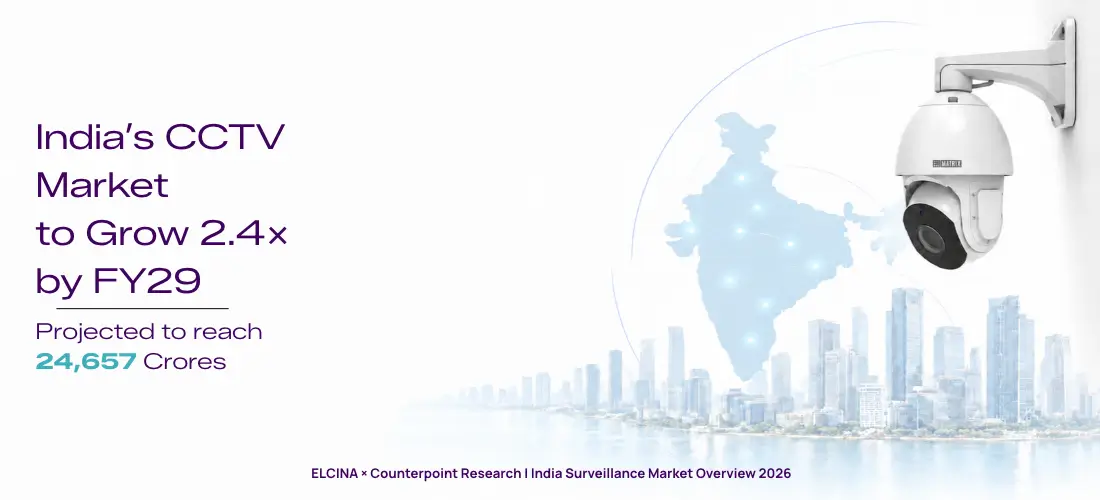
India’s surveillance industry is entering a significant phase of transformation. The India Surveillance Market Overview 2026, developed by ELCINA and Counterpoint Research, projects India’s CCTV market to grow from ₹10,257 crore in FY26 to ₹24,657 crore by FY29, representing a 2.4× expansion at a 34% CAGR.
However, this growth extends beyond market size. India’s surveillance ecosystem is moving towards greater adoption of IP-based technologies, AI-driven capabilities, stronger cybersecurity, and deeper domestic technology development.
The report highlights the rapid rise of Indian-origin brands in the IP-camera segment. Their share of IP-camera revenue increased from 27% in FY25 to 73% in FY26, reflecting the growing capabilities of domestic technology companies and manufacturers. With IP cameras and NVRs expected to account for 85% of CCTV revenue by FY29, the industry is moving towards increasingly technology-intensive surveillance deployments.
At the same time, localisation is moving beyond product assembly. Capabilities are increasingly developing across PCB assembly, firmware, software, product engineering and system integration. As surveillance products become more intelligent and connected, engineering ownership and secure product design are becoming increasingly important.
The evolving regulatory environment is reinforcing this shift. The Essential Requirements for Security under MeitY’s framework place greater emphasis on cybersecurity, trusted components, firmware traceability and supply-chain security, with STQC playing a key role in testing and certification. STQC’s certified-product list also includes Matrix Comsec network cameras under the Essential Requirements framework.
Contributing to the report, Ganesh Jivani, CEO and MD, Matrix Comsec, said: “Across the world, surveillance is being redefined by AI, cybersecurity-by-design and trusted technology supply chains. India enters this transition with scale and with a growing capability to develop technologies of its own. This makes the report particularly timely. It captures the collective progress of Indian brands across product engineering, software, manufacturing and system integration, while identifying the capabilities required for the next phase of growth. For Matrix, contributing to this endeavour means continuing to invest in indigenous R&D, engineering ownership and integrated enterprise solutions. With globally benchmarked standards and a strong domestic ecosystem, India can emerge not only as one of the world’s largest surveillance markets, but also as one of its most trusted technology partners.”
The next phase of growth will therefore depend on strengthening capabilities across manufacturing, semiconductors, AI, cybersecurity and product engineering. For India, the opportunity is to move beyond being a large surveillance market and build a stronger technology ecosystem capable of designing, engineering and scaling secure, intelligent and globally competitive security solutions from India.