
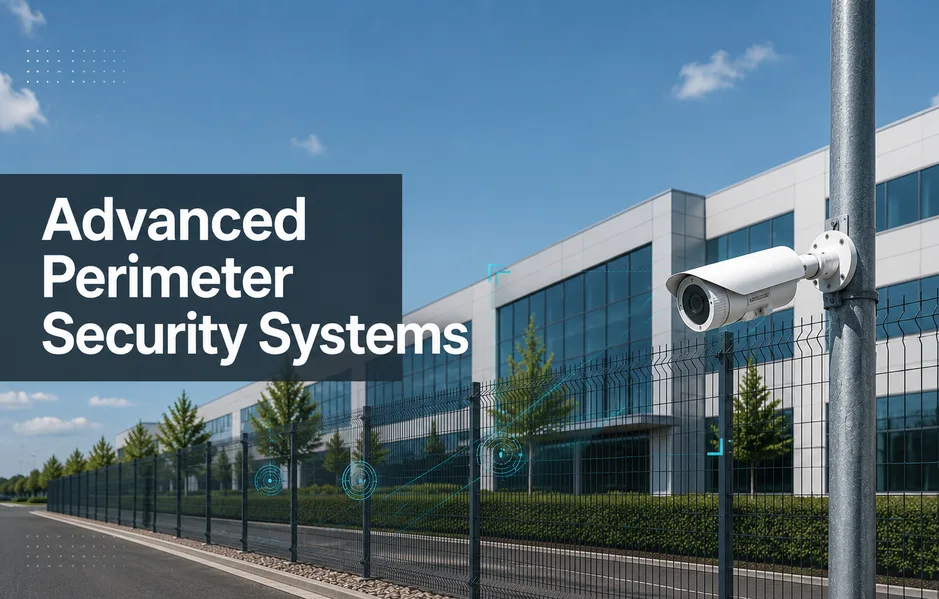
Many sites still rely on basic CCTV and roaming guards at the fence. It works, but it does not think or coordinate. Blind spots around parking, loading bays, and shared boundaries stay exposed.
Across many regions, theft, vandalism, and safety incidents often start in these fringe areas. Insurers increasingly look for documented perimeter protection and video‑verified alerts, especially for higher‑risk sites such as warehousing, retail chains, and logistics.
Advanced perimeter security systems now combine smart detection, controlled access, and resilient communication into one managed layer. Modern business perimeter security solutions use integrated perimeter security systems for enterprises that support both urban campuses and remote facilities.
You pay once, scale later, and prove compliance with clear audit trails.
Next, we will unpack what a perimeter security system includes today.
What Exactly Is a Perimeter Security System?
A perimeter security system brings together tools that detect, verify, and respond to threats at the outer edge of your site. It turns the space around your buildings into a managed security layer.
Typical components include:
- Outdoor cameras with video analytics
- Gates, barriers, and turnstiles
- Intrusion sensors on fences, walls, and rooftops
- Smart lighting and public address speakers
- Intercoms, VoIP, and central management software
Advanced perimeter security systems for businesses often connect these devices into integrated perimeter security systems for enterprises that also support internal communication and incident workflows.
How Do Traditional and Modern Perimeter Security Systems Differ?
Old system:
- Static cameras, DVRs, and paper logs
- Guards walking rounds and spotting issues late
Modern system:
- Intelligent detection with real‑time alerts
- Linked video, access control, and voice for faster action
The result is fewer missed events and more proactive responses when businesses use modern perimeter security technologies.
Where Does Perimeter Security Start and End on Your Site?
Key zones to map:
- Outer fence and gates
- Parking and walkways
- Loading docks and service entries
- Rooftop and critical plant areas
Complex office parks and remote hubs need tailored coverage, not just a line on a site map.
Next, we will explore why this outer layer is so critical for your business and how business perimeter security solutions can support daily operations.
Why Are Perimeter Security Systems So Critical for Businesses?
Incidents usually start outside. Theft, assault, and vandalism often move from parking lots to doors before anyone reacts. That delay is the real risk.
Old approach vs modern approach:
- Old: cameras that only help after the event
- Modern: perimeter systems that detect and trigger response early
Weak perimeters create:
- Direct loss and site downtime
- Reputation damage with customers and staff
- Higher insurance friction and disputed claims
Stronger perimeter security cuts incidents, speeds response, and supports compliance across sites with different risk profiles.
How Do Insurers and Regulators Influence Your Perimeter Design?
Many insurers now expect:
- Video verification for alarms
- Access and visitor logs
- Intrusion analytics on exposed zones
This is common in warehousing, retail chains, and critical infrastructure. Better perimeter controls can support lower premiums and cleaner claims.
To satisfy auditors:
- Document policies and user roles
- Define retention and deletion rules
- Maintain clear audit trails
What About Employee Safety and Privacy Expectations?
Staff expect safe outdoor areas with:
- Lighting, cameras, and call points
- Coverage for walkways and parking zones
Privacy also matters. Use clear signs and limited retention.
Choose platforms that support privacy by design and add native communication tools. Treat the perimeter as a risk control layer.
Which Modern Technologies Power Today’s Perimeter Security?
Buying only cameras or only sensors looks simple, but it creates gaps. You juggle apps, vendors, and blame when incidents slip through.
Modern perimeter security systems work as one stack: video, analytics, access, intrusion, and communication. Matrix Comsec focuses on unified, interoperable platforms.
How Do Cameras and Video Analytics Change Perimeter Monitoring?
Old system: cameras record.
Modern system: cameras think.
Key building blocks:
- IP cameras with IR and low‑light imaging for car parks and walkways
- Thermal views for fog, dust, or remote fence lines
- Analytics such as line crossing, intrusion, loitering, left object, and vehicle detection
Results:
- Fewer false alarms
- Faster video verification
- Lower guard workload across nationwide sites
What Role Do Access Control and Intrusion Sensors Play?
Perimeter control combines:
- Gate controllers, barriers, turnstiles, and card, QR, or ANPR entry
- Fence sensors, beam detectors, and door contacts for early breach alerts
When linked with video, you see:
- Who triggered the alarm
- Where they moved
- How they entered
This turns raw alerts into clear, auditable events.
Why Are Communication and Alarms Just as Important as Detection?
Detection without voice is only evidence.
Modern perimeter security adds:
- IP intercoms, PA speakers, sirens
- Automated calls, SMS, and email via VoIP or UC platforms
Choose standards‑based, cyber‑secure components that integrate cleanly.
How Do Integrated Perimeter Security Systems for Enterprises Work?
Traditionally, cameras‑only deployments solve recording, not coordination.
Large, multi‑site enterprises then face scattered tools, weak visibility, and rising risk.
Different brands at each site create daily friction:
- Separate logins and passwords
- No shared incident history
- Complex firmware and warranty tracking
Integrated perimeter security systems for enterprises replace this with one platform that ties video, access, time‑attendance, and telecom into unified perimeter security.
What Does a Fully Integrated Enterprise Perimeter Stack Look Like?
A typical architecture for advanced perimeter security systems combines:
- Edge devices such as IP cameras, access controllers, readers, and sensors
- NVRs with a central VMS and access software
- VoIP or other IP telephony, plus a security operations center dashboard
Central policy management then defines:
- User roles and access schedules
- Alarm rules and video retention
For nationwide retail, healthcare, or logistics chains, this means one control room and shared playbooks.
Teams gain consistent responses across different sites.
How Does an Integrated Approach Differ from Camera‑Centric Alternatives?
Camera‑centric setups focus mainly on recording and live view.
Modern perimeter security technologies for businesses extend this with access control, time‑attendance, and telecom in one ecosystem.
Some vendors emphasize only premium devices or only software.
Business perimeter security solutions that blend robust hardware with unified software often scale better for SMB and mid‑market needs.
End‑to‑end platforms reduce integration gaps and keep IT overhead predictable.
They also simplify updates, support, and long‑term lifecycle planning.
How Do You Phase an Integration Journey in 3 Practical Steps?
- Standardize video and recording on a common VMS or NVR stack.
- Add perimeter access and intrusion, linked to video for instant checks.
- Integrate VoIP, alarms, and SOC workflows for unified incident handling.
What Business Benefits Do Advanced Perimeter Solutions Deliver?
Security is often treated as a sunk cost.
Budgets get cut, systems stay basic, and incidents repeat.
With advanced perimeter security, the picture changes.
You shift from camera counts to clear business outcomes.
Old approach vs modern approach:
- Old: more guards, more patrols, little proof
- Modern: analytics, unified alerts, strong evidence, fewer surprises
Results include:
- Fewer thefts and safety incidents
- Faster response and clearer accountability
- Stronger compliance trails for insurers and regulators
- Lower lifetime cost per site across large portfolios
How Do You Quantify Risk Reduction and Operational Savings?
Track:
- Drop in shrinkage and vandalism after deterrent coverage
- Fewer false alarms and unnecessary site visits
- Optimized guard routes using analytics and voice workflows
Also review:
- Insurance savings from reliable video and access logs
- Durable hardware with a high mean time between failures
What This Means for You: A Simple Evaluation Checklist
Use this checklist when comparing perimeter security from different vendors:
- Uptime and failover design
- Integration with IT and telecom
- Compliance readiness (NDAA, GDPR, SIRA, BIS, or STQC)
- Scalability for multi-site growth
- Local support strength
- Cybersecurity and open standards
Where Are Advanced Perimeter Systems Used Across Industries?
How Do Different Sectors Adapt Perimeter Security?
Nationwide, needs vary sharply. Urban offices share walls and strict privacy rules. Remote sites fight outages, wildlife, and long, dark boundaries.
Key patterns:
- Retail and logistics focus on loading bays, yards, and back‑of‑house edges with ANPR and intrusion analytics.
- Healthcare and education protect pedestrian routes, staff parking, and gate‑based visitor flows.
- Critical infrastructure and data centers rely on layered rings, redundant power and links, and tight access logs.
Matrix Comsec aligns video, access, and telecom into one platform.
How Can Multi‑Site Enterprises Standardize Perimeter Protection?
Multi‑site chains use:
- Central SOCs with cloud or hybrid video and access control.
- Shared incident playbooks that flex to local crime and regulation.
- A unified vendor ecosystem for consistent policies and easier scaling.
Start with templates, then tune them to your risk profile, layout, and compliance needs.
How Should You Move Forward with Perimeter Security?
Perimeter protection has moved from simple CCTV to advanced perimeter security systems that think, integrate, and adapt. Old system: cameras that just record. Modern system: unified protection for people, assets, and uptime.
- Audit every site, including car parks and remote yards.
- Rank risks and insurance or compliance gaps.
- Compare different vendors and OEMs.
Choose business perimeter security solutions with clear engineering ownership, open integration, and nationwide support, then commit and execute.
Conclusion
Advanced perimeter security systems turn the outer edge of your site into an active, managed layer. They link cameras, analytics, access control, intrusion sensors, and communication into one stack. This cuts blind spots, speeds response, and supports insurance and regulatory demands. It also improves staff safety in car parks, walkways, and shared boundaries.
For multi‑site enterprises, integrated perimeter security systems for enterprises reduce complexity and deliver consistent protection. You move from scattered tools to one platform with clear roles, rules, and audit trails.
The most practical next step is to map your perimeter zones, risks, and compliance needs. Then evaluate modern perimeter security technologies for businesses using a simple checklist focused on uptime, integration, scalability, and local support.
Frequently Asked Questions
How is an advanced perimeter security system different from a standard CCTV setup?
A standard CCTV setup mostly records video for later review. Advanced perimeter security systems combine cameras, smart detection, access control, alarms, and communication tools. These systems can help verify threats in real time and trigger alerts, lighting, or pre-recorded voice messages. This shifts business perimeter security solutions from passive recording to more active protection that supports faster and more focused response.
Do I really need an integrated platform, or can I keep using separate vendors?
You can run separate systems, but integration often becomes complex and fragile. Integrated perimeter security systems for enterprises can help reduce blind spots and duplicated effort. Operators use one interface for video, access, and alarms, which can cut training time and reduce handling errors. A unified platform can also simplify updates, cybersecurity controls, and audits across multiple sites and devices.
What should I look for when comparing different perimeter security vendors?
Check how well each vendor supports a broad ecosystem, not only cameras. Compare how easily their modern perimeter security technologies for businesses integrate with your IT and existing sites. Review their published approach to cybersecurity, system availability, and use of open or standardized interfaces. Also, look at regional compliance support and the quality of local engineering and post‑deployment service for long term reliability.
How can I justify the cost of upgrading perimeter security to my management team?
Build a case around risk and money. Link advanced perimeter security systems to lower exposure to theft, vandalism, and operational disruption. Include possible insurance discussions, better staff safety in parking areas, and support for regulatory duties where relevant. Show how modern platforms can cut site visits, manual checks, and unplanned maintenance calls. Present the total cost of ownership over several years, not just the upfront price.
Is cloud-based perimeter security system monitoring secure and reliable enough for mission-critical sites?
Cloud and hybrid models can be suitable if designed well. Look for strong encryption, multi‑site redundancy, and clear uptime commitments in contracts. Use hybrid designs for very sensitive or remote locations, with local recording plus cloud management. Define data governance, retention, and access rules in detail. Align your advanced perimeter security systems with internal policies and any sector regulations before large-scale rollout.