
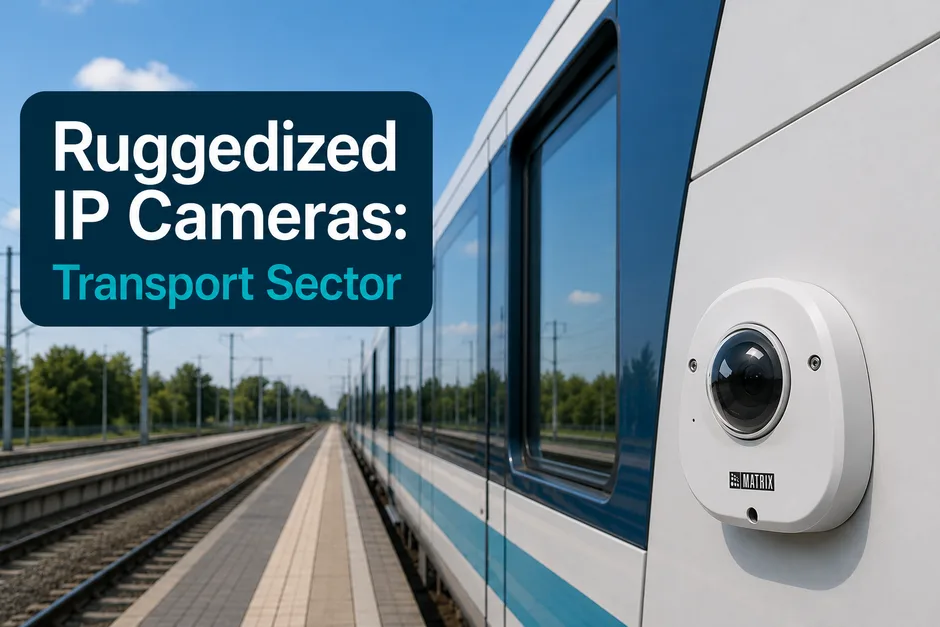
Passenger safety, asset protection, and regulation demands are rising across buses, trains, and logistics fleets. Many operators still rely on standard CCTV that cannot handle constant vibration, shocks, dust, and extreme temperatures.
This leads to blurred footage, recording gaps, and blind spots. It can also cause non-compliance, especially where IP surveillance cameras for trains must meet strict rail norms. Ruggedized IP cameras solve this by being built for harsh mobile environments. This guide covers key challenges, EN 50155 compliant cameras, and benchmarks for serious transport solutions.
What Makes Video Surveillance in Transport So Challenging?
Public transport and freight run all day across cities, depots, and remote routes. Standard cameras struggle with this pace and complexity.
Key challenges include:
- Harsh environments: extreme temperatures, humidity, dust, salt air, vibration, and shocks.
- 24×7 coverage: platforms, yards, and moving vehicles need continuous recording.
- Network dead zones: remote routes break live streaming and central recording.
- Cyber exposure: unmanaged IP devices can invite intrusion and data loss.
- Privacy and legal duties: passenger footage and retention rules must be followed.
- Reliability needs: power backup, dual connectivity, and edge storage keep footage safe.
How Do These Challenges Impact Your Daily Operations?
- Disputed incidents become long investigations when the video is blurred or missing.
- Delays, penalties, and claim fraud rise when you cannot prove events.
- Old analog DVRs and non-rugged cameras often fail during collisions or disputes.
- Transport-grade IP systems keep recording through shocks, power dips, and network loss.
This reduces manual checks and speeds complaint resolution. It also supports clear accountability across fleets.
What Are Ruggedized IP Cameras and Where Are They Used?
Ruggedized IP cameras are CCTV devices built for harsh, mobile use. Reinforced housings and protected electronics keep them recording during vibration, shocks, dust, rain, and fast temperature swings. As IP devices, they support remote access, VMS integration, and analytics.
You will see these cameras in:
- Mobile surveillance for buses and trains
- Metros, trams, and railway platforms
- Depots, yards, and maintenance areas
- Commercial fleets and shipping ports
Within railway video surveillance solutions, they protect passengers and assets. They keep recording even when vehicles move through network dead zones.
How Do Ruggedized IP Cameras Differ From Standard CCTV?
Standard indoor cameras suit fixed, stable spaces with mild temperatures. They work in offices and shops, but struggle with moving vehicles.
Ruggedized IP cameras are different. They typically include:
- Sealed enclosures that block dust, moisture, and debris
- Reinforced mounts that handle constant movement and impacts
- Extended temperature components that work in heat and cold
These cameras are tested for continuous motion, frequent shocks, and outdoor exposure. Standard models usually are not.
What Are the Key Benefits of Ruggedized IP Cameras in Transport?
Transport is one of the toughest CCTV environments. Standard cameras fail early, lose footage, or miss key details. Rugged designs solve these risks and keep systems usable.
Key benefits include:
- High durability: Ruggedized IP cameras work in extreme temperatures, humidity, and water splashes.
- Vibration and shock resistance: Design captures clear video on vehicles in motion.
- Dust and debris protection: Sealed enclosures protect electronics and image quality.
- Remote monitoring: IP connectivity supports live viewing and faster response.
- Redundancy and edge recording: Local storage preserves footage during outages.
- Standards compliance: EN 50155 and similar norms validate safety and reliability.
| Benefit | Technical Capability | Business Outcome |
| Durability in harsh environments | Withstands extreme temperature, humidity, and water or rain splashes without loss of performance | Fewer field failures and lower replacement costs |
| Vibration and shock resistance | Designed to capture clear footage despite constant motion, shocks, and vibrations | Reliable evidence for incidents during journeys |
| Dust and debris protection | Sealed enclosures shield internal components from dust, dirt, and debris | Stable image quality and longer device life |
| Remote monitoring | IP connectivity enables remote access to live and recorded video | Faster response to safety events and maintenance issues |
| Redundancy and reliability | Continuous recording with support for backup power and dual connectivity | Footage is available even during network or power problems |
| Compliance with transport standards | Meets EN 50155 and related environmental and safety requirements | Easier approvals and higher passenger trust in safety systems |
These benefits cut downtime and protect evidence. They also improve the total cost of ownership.
How Do These Benefits Support Railway Video Surveillance Solutions?
On trains and metros, cameras sit above doors, in coaches, gangways, and driver cabins. All these points face vibration, shocks, and temperature swings.
Ruggedized IP surveillance cameras for trains keep recording under these stresses. They also record during route segments with weak connectivity. Ruggedized IP cameras often form the backbone for rail video. They help manage crowds, respond faster to incidents, and deter vandalism.
Why Does EN 50155 Compliance Matter for Railway Cameras?
EN 50155 is the core European standard for electronic equipment in rolling stock. It defines how devices must perform under real rail conditions.
It covers environmental factors such as:
- Temperature ranges
- Humidity levels
- Vibration and shock on moving vehicles
It also includes safety and reliability aspects:
- Electromagnetic Compatibility and electrical needs
- Fire and smoke regulations
- Vibration and shock resistance
- Documentation, testing, marking, and maintenance
| EN 50155 Area | What It Covers | Impact on Cameras |
| Environmental conditions | Temperature ranges, humidity levels, vibration, and shock | Cameras keep working in extreme and constantly changing rail conditions |
| Safety and performance | Safety standards and performance criteria for railway systems | Stable, predictable operation that supports passenger and worker safety |
| EMC and electrical | Electromagnetic Compatibility and electrical requirements | Less interference with other train systems and more reliable power behavior |
| Fire and smoke | Fire and smoke regulations | Hardware that supports overall fire safety strategies on rolling stock |
| Lifecycle and service | Documentation, testing, marking, labeling, maintenance, and serviceability | Easier approvals, inspections, and long-term maintenance planning |
Many operators now treat EN 50155 compliant cameras as the baseline. These devices are built for long-term safety and reliability. In India, IP cameras meeting RDSO standards are treated as the baseline.
This supports audit readiness and reduces surprise failures. It also aligns systems with real rail operations.
How Does EN 50155 Fit With Other Protection Ratings?
Ratings like IP67, IK10, and NEMA 4X focus on dust, water, and impact resistance.
EN 50155 focuses on railway operating conditions such as vibration, shock, and temperature. It also addresses system-level safety.
Look for cameras that combine EN 50155 with ingress and impact ratings. This covers both the rail environment and daily physical abuse.
Why Are Vibration and Shock-Proof Features Non-Negotiable?
On trains and buses, motion, rough tracks, and braking all shake the chassis. Coupling impacts add more stress.
Without vibration and shock-proof CCTV, cameras can miss key frames. Critical details may blur at the moment of impact.
Modern Ruggedized IP Cameras use:
- Reinforced mounts and shock-resistant housings
- Image stabilization to steady each frame
- Robust CMOS sensors that resist impact and misalignment
- Anti-vandal domes that protect against kicks and tampering
This delivers usable evidence during real incidents, not only in lab tests.
How Do Edge Recording and Redundancy Support 24×7 Coverage?
When vehicles lose connectivity, cameras can record to on-board storage. Video stays on the camera until the link returns.
Once the network is back, footage syncs to central storage in the background. Dual connectivity and power backup keep recording active in most faults.
This ensures continuous timelines for investigations and compliance. Mobile surveillance does not stop when the signal drops.
How Should You Evaluate Ruggedized IP Cameras for Transport?
Where Should You Start?
Begin by mapping use cases by fleet type, route profile, and risk zones. Buses, freight, and rail cars face different threats.
Then move through a simple checklist.
- Match each vehicle and route to likely conditions and low signal areas.
- Check ratings: IP and IK for dust, water, and impact, EN 50155 for rail.
- Validate resistance to vibration and shocks, plus the operating temperature range.
- Review cybersecurity, remote access, and VMS integration.
- Confirm redundancy: edge recording, dual connectivity, and backup power.
- Choose vendors with strong engineering and long-term service records.
| Evaluation Area | Key Questions to Ask | Why Ruggedized IP Camera Matters |
| Harsh environment readiness | Can the camera withstand extreme temperatures, dust, moisture, vibrations, and shocks across your routes? | Transport equipment must operate in harsh conditions without losing performance or failing. |
| Vibration and shock resistance | Is the housing shock-resistant and can it capture clear footage under constant motion and impacts? | Trains and buses experience continuous vibrations that can blur images and damage unprotected cameras. |
| Environmental and impact ratings | Does the solution carry ratings like IP67, IK10, NEMA 4X, and for rail, EN 50155? | These ratings indicate protection from water, dust, impacts, and rail-specific stresses. |
| 24×7 operation and redundancy | Does it support continuous recording, edge storage, dual connectivity, and backup power options? | Continuous surveillance and redundancy prevent gaps in footage during faults or outages. |
| Cybersecurity and privacy | How is video data protected from cyber attacks while respecting passenger privacy and legal rules? | IP cameras are exposed to networks, so data and systems must be secured and compliant. |
| Remote and mobile deployment | Can it record reliably in remote areas with limited or no network coverage? | Transport routes often cross low coverage zones, so on-board recording is vital for investigations. |
This approach supports safer operations across your network.
Frequently Asked Questions
What is the difference between standard CCTV and ruggedized IP cameras for transport?
Ruggedized IP cameras are built for harsh mobile environments. Standard CCTV suits stable indoor sites. Transport cameras use sealed housings, extended temperature ranges, and higher IP and IK ratings. They resist vibration, shock, and dust. Many are tested to rail, road, or marine standards.
Why should railway operators insist on EN 50155 compliant cameras?
EN 50155 compliant cameras are designed for railway conditions. These include temperature, humidity, shock, and vibration. The standard helps ensure cameras keep working over long service lives. It also supports safety cases and regulatory audits. Using compliant devices simplifies fleet approval and incident investigation.
How do ruggedized IP cameras handle poor or no network connectivity on routes?
Ruggedized IP cameras usually support edge recording and local storage. They capture high-quality footage to internal SD cards or vehicle recorders. When the train or bus reconnects, stored video can sync to central systems. This protects incident evidence along remote routes.
Can vibration and shock-proof CCTV really improve incident evidence quality?
Yes. Vibration and shock-proof CCTV can greatly improve evidence on moving vehicles. Ruggedized IP cameras use reinforced mounts and housings that reduce blur. Many models include digital image stabilization and robust sensors. This keeps faces, signals, and instrument panels readable during investigations.
What should transport operators look for when selecting ruggedized IP cameras?
Operators should check IP and IK ratings plus relevant rail or road standards. EN 50155 and EN 45545 fire safety norms are common rail needs. Cybersecurity features such as encrypted streams and user access control are also key. Look for storage redundancy, health monitoring, and remote updates. Vendor support and VMS integration matter as much as hardware.
Conclusion
Ruggedized IP cameras give transport operators reliable video where standard CCTV fails. They handle heat, cold, dust, vibration, shocks, and network gaps across buses, trains, and depots. Your next step is to map risks by route and vehicle, then apply a clear checklist for ratings, redundancy, and integration. Choose cameras built for harsh mobile use, not adapted from indoor spaces.