
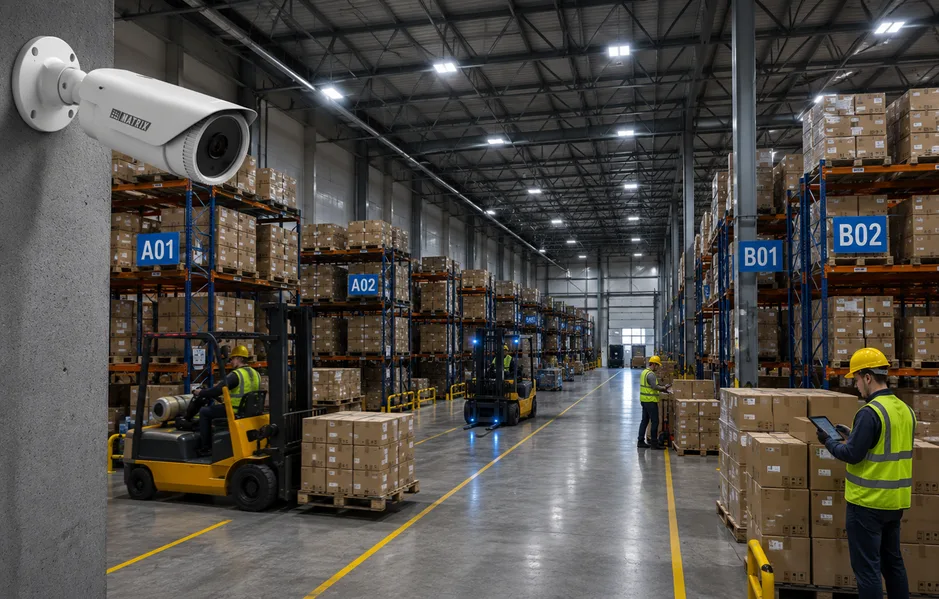
Traditional warehouse security cameras were built for single sheds and small teams. Today, warehouses are larger, spread across sites, and harder to monitor with basic CCTV alone.
Old systems record, but they do not help you react. Blind spots, delayed alerts, and manual screen watching all increase shrinkage and safety risk.
This article looks at smarter warehouse video surveillance that does more than capture footage. Modern IP cameras for a warehouse can protect stock, people, and perimeters in real time.
What Are Your Real Options Beyond Traditional Warehouse CCTV?
How do old systems hold you back?
Traditional warehouse security cameras still do the basics, but they create risk:
-
- Limited views and blind spots
- No in-built alerts or analytics
- Local-only viewing and manual checks across sites
You see what happened, but usually after the loss.
| Aspect | Traditional CCTV | Modern IP Security Cameras |
| Stock visibility | Hard to track every corner, with more blind spots. | A wide field of view (up to 127°) helps cover more area with fewer gaps. |
| Image detail | Lower clarity makes small items and events harder to see. | The 5 MP resolution with Sony STARVIS sensor captures fine details with less noise. |
| Lighting handling | Struggles with strong backlight or mixed lighting. | True WDR balances bright and dark areas for clearer footage. |
| Alerts and response | No built-in event alerts, relies on manual monitoring. | Motion, intrusion, tripwire, tamper, and other analytics push instant notifications. |
| Multi-site monitoring | Typically tied to on-site viewing and control. | Notifications and monitoring can cover multiple warehouses at once. |
| Perimeter protection | Often operates alone, without other systems. | Integrates with motion sensors, alarms, access control, and more for layered defense. |
What does a modern option look like?
IP security cameras for warehouses add:
- Real-time alerts on defined events.
- Integration with perimeter and safety systems.
- Smart streaming and compression to cut storage and bandwidth costs.
How Do Modern Warehouse Cameras Improve Stock Tracking?
Old warehouse video often misses small items, blind spots, and key moments.
You only discover gaps when stock counts fail.
Modern warehouse security cameras change that by covering more space with fewer views and clearer detail. A 5 MP Matrix Bullet camera with a 127° horizontal field of view helps you see full aisles, racks, and loading zones without constant camera hopping.
| Capability | Why It Matters | What To Look For |
| Wide field of view | Reduces blind spots and the number of cameras needed. | Horizontal coverage similar to 127° to see full aisles and corners. |
| High resolution (5 MP) | Captures fine details that support audits and investigations. | 5 MP image quality so small items and actions stay visible. |
| High Quality Sensors | Improves clarity and detail, even in low light. | A back-illuminated CMOS sensor delivers a higher signal-to-noise ratio. |
| True Wide Dynamic Range (WDR) | Balances bright and dark areas for usable footage. | WDR that evens out harsh lighting in mixed indoor scenes. |
| Noise reduction | Keeps images clear so that evidence is easier to review. | Technology that reduces image noise for sharper stock views. |
You get faster dispute resolution, fewer manual checks, and stronger audit trails when stock goes missing.
What Should You Look For In Stock-Tracking IP Cameras?
Treat these as minimum criteria when shortlisting IP security cameras for warehouses:
- At least 5 MP resolution for item-level clarity.
- Wide field of view to cut blind spots in aisles and bays.
- Low-light technology, such as Sony STARVIS, for dim zones.
- True Wide Dynamic Range (True WDR) for mixed lighting in loading bays.
- Integration with your video or warehouse management systems.
Focus on how each feature helps staff find answers quickly, not just on the spec sheet.
How Can Alerts And Analytics Replace Manual Monitoring?
Old way: guards stare at screens, miss key moments, and react late.
This gets worse when one team covers several sites.
Modern IP security cameras use built-in video analytics.
The system watches for risk and pushes alerts the moment rules are triggered.
| Analytics Feature | Typical Use In Warehouses | Key Outcome |
| Motion detection | Spot movement in sensitive areas when activity is not expected. | Enables instant alerts so staff can respond before damage occurs. |
| Intrusion detection | Detect entry into restricted zones or outside working hours. | Helps contain security breaches quickly. |
| Tripwire detection | Monitor crossings along virtual lines at gates or aisles. | Flags unusual movement patterns for review. |
| Tamper detection | Identify attempts to cover, move, or disable cameras. | Protects the integrity of monitoring. |
| Missing object detection | Track when goods or assets disappear from a scene. | Supports quick action on potential theft or loss. |
| Object counting | Count items or people moving through key points. | Helps manage flow and detect irregular volumes. |
| Loitering detection | Detect people staying too long in sensitive spots. | Reduces chances of planned theft or misuse. |
Across multiple warehouses, alerts can be centralized.
Operators focus on the few events that matter, not hundreds of quiet cameras.
What This Means For You: From Reactive To Proactive Security
You move from checking footage after a loss to stopping incidents as they start.
Results include:
- Lower shrinkage and fewer stock disputes.
- Safer staff and faster investigations.
When you compare warehouse security cameras, favor systems that let you set clear rules and send alerts through your video platform, email, or mobile apps.
How Do You Strengthen Perimeter Security For Warehouses?
Many warehouse incidents begin at the boundary, not inside the racks. Basic cameras that only record video help after a loss, but do little to stop intrusions in real time. With warehouse security cameras that work in sync with other devices, the outer fence becomes an active shield, not a weak line.
| Perimeter Risk | Supporting Devices | Camera Role |
| Intrusion at the boundary | Motion sensors, intrusion alarms, and electrified fences | Capture video and send snapshots or recordings when an intrusion device triggers. |
| Forced entry through gates or doors | Access control systems, intrusion alarms | Record events around access points and push instant notifications to the right person. |
| Fire or safety incident near the fence | Fire alarms | Provide visual confirmation when a fire alarm activates at the perimeter. |
| Tampering with physical barriers | Motion sensors, intrusion alarms | Deliver clear footage when barriers are disturbed so teams can verify threats quickly. |
| Unauthorized movement around the site edge | Motion sensors | Monitor continuous activity and support real-time alerts across multiple warehouses. |
Modern IP security cameras integrate with these systems, so every trigger is matched with visual proof. This helps cut false alarms, speed up checks, and support safer, more compliant sites nationwide.
What This Means For You: Building A Layered Defense
Think in three simple steps: detect, verify, respond.
- Detect: Motion sensors, alarms, and access control spot unusual activity first.
- Verify: Integrated cameras provide clear images or clips in seconds.
- Respond: Your team acts only on confirmed threats, not guesswork.
The result is fewer breaches, fewer wasted patrols, and faster decisions. When you assess IP security cameras for warehouses, look for solutions that link smoothly with your existing alarms and access control, or consider a unified stack like Matrix for simpler, end-to-end perimeter protection.
How Can The Right IP Cameras Cut Your Surveillance Costs?
Running 24×7 monitoring across large sites gets expensive. Bandwidth, storage, and guard time all add up fast. Modern warehouse security cameras help you spend smarter, not more:
- Adaptive streaming reduces bandwidth when there is no motion.
- Smart streaming and region of interest keep key areas in full detail.
| Feature | How It Works | Cost Impact |
| Adaptive Streaming | Automatically reduces bandwidth consumption when there is no motion detected in the video. | Lowers network usage and storage needs during idle periods. |
| H.265 Compression | Compresses video footage while keeping the same information. | Optimizes storage consumption by up to 50 percent. |
| Smart Streaming | Adjusts video data intelligently based on scene content. | Reduces overall monitoring costs by limiting unnecessary data. |
| Region of Interest | Focuses higher quality on selected areas in the frame. | Saves bandwidth and storage on less important parts of the scene. |
With modern IP security cameras, you pay once for smart features. You can add more cameras later without a matching jump in network or storage spend.
What This Means For You: Plan For Scale, Not Just For Today
Think three to five years ahead, not just this budget cycle. Model how many sites and cameras you will add as the business grows.
Then:
- Choose warehouse video surveillance solutions that can scale without a full network redesign.
- Check and compare camera specifications when choosing vendors.
- Prioritize features that delay new storage and bandwidth upgrades, so every new camera adds protection, not overhead.
Why Do Hardware Quality, Environment, And Compliance Matter?
Harsh warehouses are where cheap cameras fail first.
Cold storage, dust, and 24×7 operation expose weak hardware fast.
Old approach: buy the lowest-cost device and replace it often.
Modern approach: treat IP security cameras as long-term infrastructure.
Matrix builds cameras to run in demanding sites, with in-house R&D, long MTBF, and cybersecurity-by-design so devices stay stable, secure, and always on.
| Factor | Why It Matters | Typical Benchmarks/Standards |
| Operating Temperature | Warehouses can be extremely cold or hot, and cameras must keep working to avoid gaps in coverage. | Operational between -30°C and 60°C in cold and normal warehouses. |
| Environmental Robustness | Hardware must deliver seamless footage even in harsh storage conditions. | Built with superior hardware components for reliable operation. |
| Safety & Quality Compliance | Certified products indicate controlled materials and tested performance. | Adheres to CE, FCC, BIS, and RoHS standards. |
Prefer certified, standards-aligned warehouse security cameras over non-certified imports that look cheap, then fail when you need them most.
How Should You Shortlist Your Next Warehouse Camera Partner?
Old CCTV just records. Modern warehouse security cameras think, integrate, and comply with standards so you can act in real time, not after loss.
Use this quick checklist: image clarity, smart analytics, system integration, bandwidth and storage control, reliability, and certifications. Speak with experts, compare options, and treat modern capabilities as the minimum benchmark for any nationwide warehouse rollout.
Conclusion
Modern warehouse security cameras should do more than record. They must help you see stock clearly, secure the perimeter, and react in real time. You cut blind spots, reduce manual monitoring, and scale without runaway storage or bandwidth costs. As a next step, compare your current setup against these capabilities and use them as a benchmark for future upgrades.
Frequently Asked Questions
What is the difference between traditional CCTV and modern IP security cameras for warehouses?
Traditional CCTV uses analog signals and fixed recording. This limits image quality and flexibility. Modern IP security cameras use digital video, higher resolutions, and advanced analytics. They support remote access from browsers and mobile apps. They also integrate better with video management, warehouse management, and access control systems. This enables long term scalability and easier expansion as storage or operations grow.
Which camera features matter most for stock tracking in large warehouses?
For stock tracking, resolution is critical so labels, pallets, and barcodes stay readable. Wide field of view helps cover long aisles with fewer cameras.
Low-light technology keeps images clear in dim storage zones.
Wide Dynamic Range handles strong backlight from loading bays.
Together, these features reduce blind spots and support accurate stock audits and verification.
How can warehouse security cameras help reduce overall surveillance costs?
Modern IP cameras lower costs through efficient video handling. H.265 compression cuts storage and bandwidth needs while keeping key details. Adaptive streaming and smart streaming adjust quality by scene activity and viewing device. Region of interest recording keeps high quality only where it matters, such as doors or high-value racks. This allows fewer recorders and lower network load, with better total cost of ownership.
Why should warehouse cameras be integrated with perimeter and access control systems?
Integration creates a single security picture across gates, doors, and storage zones. When a fence sensor or door controller triggers an alarm, the system can pull the exact camera feed. This supports quick visual verification and reduces false alerts. Security teams can track intruders from the perimeter to the rack in real time. Faster, informed responses protect staff, stock, and loading operations.
Why is standards compliance important when choosing warehouse video surveillance solutions?
Standards-compliant warehouse cameras and recorders are easier to integrate and maintain. Compliance with industry norms and cybersecurity guidelines supports secure network deployment. It also helps meet legal and regulatory needs for video retention and access control. Certified products are usually tested for reliability and safety. This reduces long-term legal risk and unexpected downtime in critical warehouse workflows.