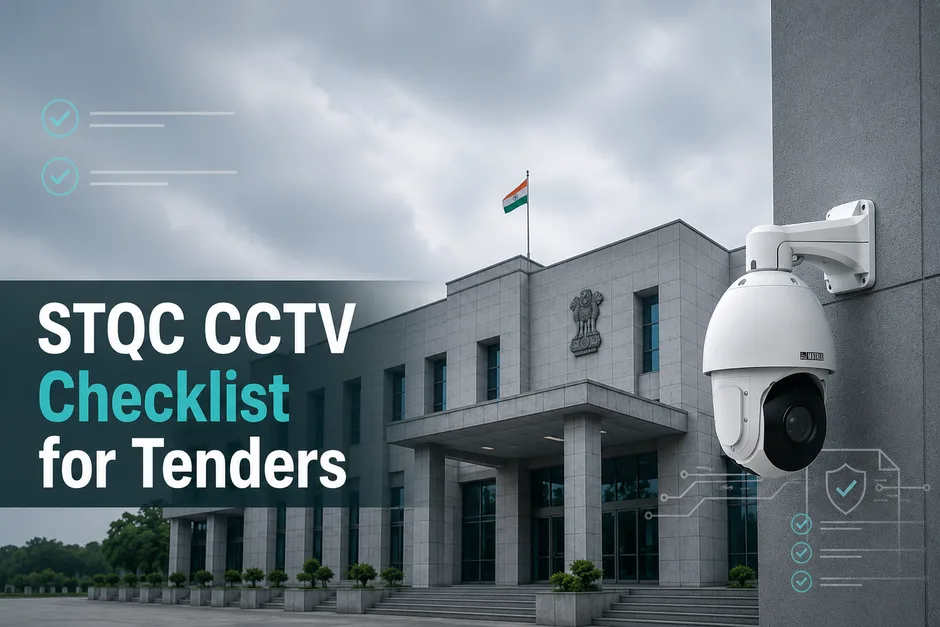
Government and PSU departments across India now face strict checks on CCTV safety. As cyber threats grow, older systems often lack secure firmware. They also lack secure video encryption to protect data. These gaps can expose critical systems to hacks and data leaks.
The risks of using old CCTV hardware are high. Today, security issues affect both safety and compliance. Buying teams must match their plans with government CCTV requirements in Indian laws. Many tenders now require the use of BIS STQC certified cameras to protect public data.
Our guide offers a simple STQC CCTV checklist for your project. This list helps you prepare for STQC-compliant CCTV solutions for tenders. Following these rules is no longer optional. It is the best way to build a secure and auditable system.
Key Takeaways for Procurement Teams
- Reduce Bid Risk: Check BIS registration and valid STQC reports early in the project.
- Keep Data Local: Pick solutions with clear local hosting options in India.
- Lower Long-Term Costs: Invest in systems that keep secure, verifiable logs.
How to Start Your Project
- Check the Rules: Study the latest MeitY and CERT-In rules for camera safety.
- Compare Specs: Match your technical specs with current STQC test rules.
- Check Vendor Files: Validate vendor proof for data location, encryption, and firmware updates.
Matrix STQC CCTV solutions are built to meet these goals. They focus on secure firmware and clear event logging. This helps system integrators meet compliance rules. It also keeps the design simple for government projects.
Why is STQC Certification Key for Indian Tenders?
Government buyers now focus more on cybersecurity. Cameras are no longer just simple hardware. A weak device can expose your whole network to risk.
In India, MeitY has issued rules on secure ICT products. Many tenders reference these rules to define government CCTV requirements and policies in India. This forces projects to check security along with cost.
BIS Safety vs. STQC Security
Many buyers confuse the standard BIS safety mark with STQC testing. The difference is simple. BIS registration focuses on electrical and product safety. It prevents fires, electric shocks, and unsafe builds.
STQC testing under MeitY provides testing and quality evaluation. It checks firmware behavior, communication security, and device safety. Reports from STQC-associated Indian test labs are key.
Using BIS STQC certified cameras shows you follow national safety rules. Some tenders ask for Matrix STQC CCTV or similar certified products. This helps buyers compare vendors on security, not just price.
Save Time in Technical Rounds
Missing these rules can delay your project. Non-compliant hardware is often rejected in the technical round. Early checks save time:
- Read RFPs Early: Check the rules for STQC-compliant CCTV solutions for tenders in the RFP.
- Ask for Lab Reports: Ask for authentic lab reports, not just self-papers.
- Check Local Storage: Confirm the VMS and storage meet local data rules.
Working with an Indian maker makes audits much simpler. It reduces friction across complex projects.
The Technical Checklist: Camera Hardware and Firmware
PSU projects demand secure cameras. Weak hardware can lead to network hacks or project delays.
The STQC CCTV checklist is your first line of defense. It keeps your network secure. Use these three steps to check your hardware:
- Check Firmware Safety: Check that the camera software has no hidden backdoors.
- Use Encryption: All video data must use secure encryption (TLS) during transmission.
- Choose Secure Designs: Make sure security is built into the device software from the start.
Matrix Comsec develops its software in-house. We own the entire code. This ensures there are no third-party backdoors or security gaps. According to cybersecurity reports, nearly 70% of connected IoT devices, including IP cameras, contain critical firmware vulnerabilities that lack updates. This gap turns a safety asset into a network risk.
Physical Durability for Indian Conditions
Indian sites face harsh weather. Hardware must be tough to last long.
- Weather Safety: Choose cameras with IP66 or IP67 ratings. This keeps out rain and dust.
- Power Safety: Use devices with built-in surge safety. This helps handle voltage spikes.
- Rust Safety: Use corrosion-resistant materials for coastal setups.
Old CCTV vs. Modern STQC CCTV
| Feature | Legacy CCTV Systems | Modern STQC-Compliant CCTV |
| Security | Simple password protection. | Encrypted firmware, secure TLS communication, and stronger cybersecurity. |
| Data | Vulnerable to network breaches and unauthorized access. | Supports data localization and enhanced data protection. |
| Build Quality | Generic plastic or metal housing. | IP67-rated weatherproof, surge-protected, and built for harsh environments. |
Software and Integration: VMS and Data Sovereignty
Managing security across large PSU sites is a challenge. Old systems often work in silos. This makes it hard to track incidents. Without a central Video Management System (VMS), teams waste time searching for footage.
The solution lies in an STQC CCTV checklist that focuses on software setup. Modern VMS platforms must connect with state data centers. Data studies show that multi-location enterprises and PSUs face growing threats. Database leaks and unauthorized access account for nearly 40% of public sector security incidents. This highlights the need for a secure VMS.
Why Central VMS Matters
- One Dashboard: Manage all cameras from one screen.
- Audit Logs: Record all user actions for audit compliance.
- Easy Setup: Connect the VMS with fire alarms and access control.
Data Localization and the DPDP Act
Modern government CCTV requirements in India demand strict data control. The DPDP Act requires all surveillance data to stay in India. Storing data on foreign servers is not allowed. You must ensure your VMS supports local servers or local clouds.
Role-based access is also key. Only verified users should see specific feeds to prevent leaks.
Old VMS vs. Modern STQC VMS
| Feature | Legacy VMS | Modern STQC-Compliant VMS |
| Storage | Foreign cloud storage. | Indian data centers with data localization support. |
| Access | Shared passwords and limited access control. | Role-based access control (RBAC) with granular permissions. |
| Logs | Basic logging or no audit trail. | Comprehensive forensic audit logs for complete traceability. |
Matrix builds VMS software specifically for Indian PSU needs. We provide the files you need for GeM and CPPP tenders, reducing your compliance risks.
The STQC CCTV Procurement Checklist: Documentation and Bid Preparation
Tenders require a lot of paperwork. A missing file can disqualify a strong bid. The STQC CCTV checklist is now a key part of government CCTV requirements in India. If your files do not match, your bid will be rejected.
How to Map Certificates
To prepare your bid, match your reports with CPPP or GeM rules:
- Check Model Numbers: Ensure your lab reports list the exact camera models you propose.
- Check Lab Details: Record the report number and date. Keep soft copies ready.
- Submit MII Letters: Provide ‘Make in India’ letters to show local content.
Simplify Document Packs
Gathering files takes time. Document packs for Matrix STQC CCTV models group all certificates together. This makes your bid preparation faster.
Post-Installation: Site Acceptance Tests (SAT)
The job is not done when the cameras are up. Site Acceptance Tests check that the system works as promised:
- Check Performance: Check video quality, network speed, and security controls on site.
- Plan Maintenance: Set up regular logs and software updates to keep the system safe.
Conclusion
Safe PSU networks require strict CCTV checks. Using a clear STQC CCTV checklist helps you avoid bid loss. Before you submit your bid, check that all model numbers match their test reports. Choosing certified cameras ensures a secure future for India’s digital growth.
Frequently Asked Questions
Can I use non-STQC cameras with BIS safety marks?
No. BIS checks electrical safety. STQC checks cybersecurity and firmware. For government CCTV projects in India, you must use BIS STQC certified cameras or equivalent tested models.
How do I check an STQC report?
Check the report number on the test lab’s website. Ensure the model numbers and firmware versions match your bid. Many buyers prefer lab reports for STQC-compliant CCTV solutions for tenders. Ask your OEM for a documentation pack.
Does STQC apply to the VMS software?
Mainly to camera hardware. However, the VMS must support secure protocols. This includes encrypted video, role-based access, and audit logs.
Why is ‘Make in India’ important for tenders?
Many tenders give preference to local products. Working with Indian OEMs like Matrix provides quicker support. It also ensures transparent firmware.
Why Choose Matrix?
As an Indian OEM, we manage everything from circuit design to local support. We provide pre-validated document packs for GeM and CPPP tenders to save you time.