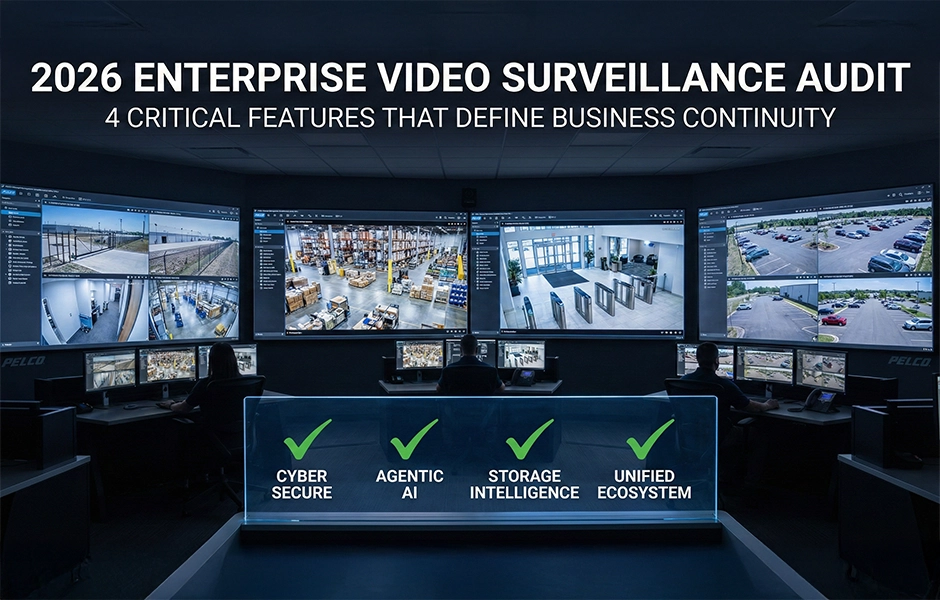
The era of buying a video surveillance system as a “background facility tool” is over. We have entered the age of Visual Intelligence.
According to the 2026 SIA Security Megatrends, software has officially “eaten the world,” and the industry is now grappling with an even bigger question: Will AI eat software?
For organizations managing multiple locations, surveillance systems now influence cyber risk, audit readiness, and long-term scalability. According to the 2024 Hiscox Cyber Readiness Report, 67% of organizations reported experiencing at least one cyber attack in the past 12 months, reinforcing the reality that connected systems, including network cameras and IoT endpoints, are now part of the enterprise threat surface.
This shift has changed how video surveillance systems should be evaluated. The conversation is no longer about megapixels or lens specifications. It is about questions such as:
Is this system cyber-secured?
Can it scale without becoming difficult to manage?
Will it stand up to audits and compliance checks over time?
So how should enterprises actually evaluate a video surveillance system in 2026?
Cybersecurity as a baseline, not a feature
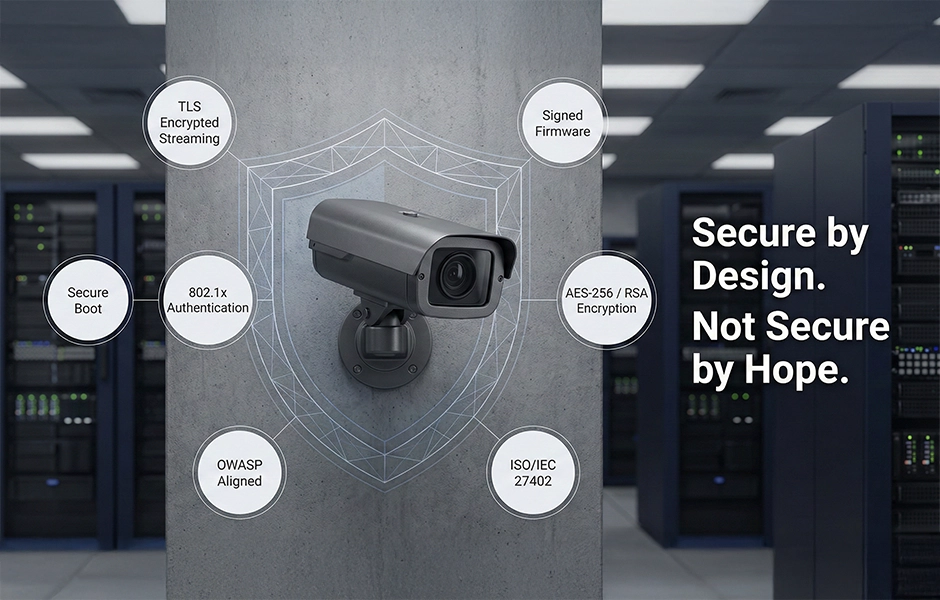
Gone are the days when a video surveillance system was just a passive observer. Every camera is a potential doorway into your entire business network. If that door is weak, it doesn’t matter how strong your main firewall is—hackers will just climb in through the window. A hacker will own that device and use it as a launchpad to jump sideways into your payroll system. We must treat security cameras with the same rigor as an employee’s laptop—moving from “hoping it’s safe” to “proving it’s safe.”
That proof isn’t found in a datasheet claim; it is found in rigorous third-party validation. Today, baseline trust is established only through compliance with global norms like OWASP, ISO/IEC 27402, and certifications such as STQC. Before a device touches your network, it must demonstrate this “Secure by Design” architecture through tangible technical defenses: Signed Firmware that rejects malicious updates, Encrypted Video Streaming (HTTPS/TLS) that prevents eavesdropping, and 802.1x Authentication that ensures only authorized hardware can communicate with your server.
The Rise of “Agentic AI”: From Detection to Prevention
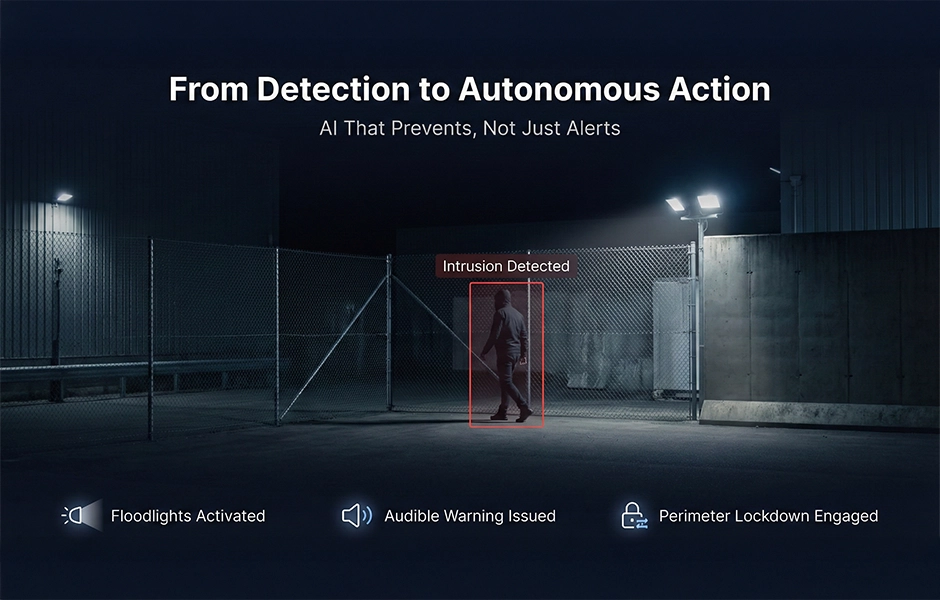
For years, the industry promised AI that could “detect” anomalies. In 2026, detection is the bare minimum. The new standard is “Agentic AI”—autonomous systems capable of interpreting data, making decisions, and executing complex workflows without human intervention.
In practice, this means moving from a system that merely watches to a video surveillance system that works. Consider the “Invisible Intruder” scenario: instead of simply flagging a 3:00 AM perimeter breach for a drowsy guard to verify, Agentic AI instantly validates the tripwire violation against shift schedules, triggers floodlights to stun the intruder, and broadcasts an automated audio warning—all while simultaneously locking internal access doors to contain the threat before a human operator even sees the alert.
The “Return on Security” (RoS): Storage Intelligence
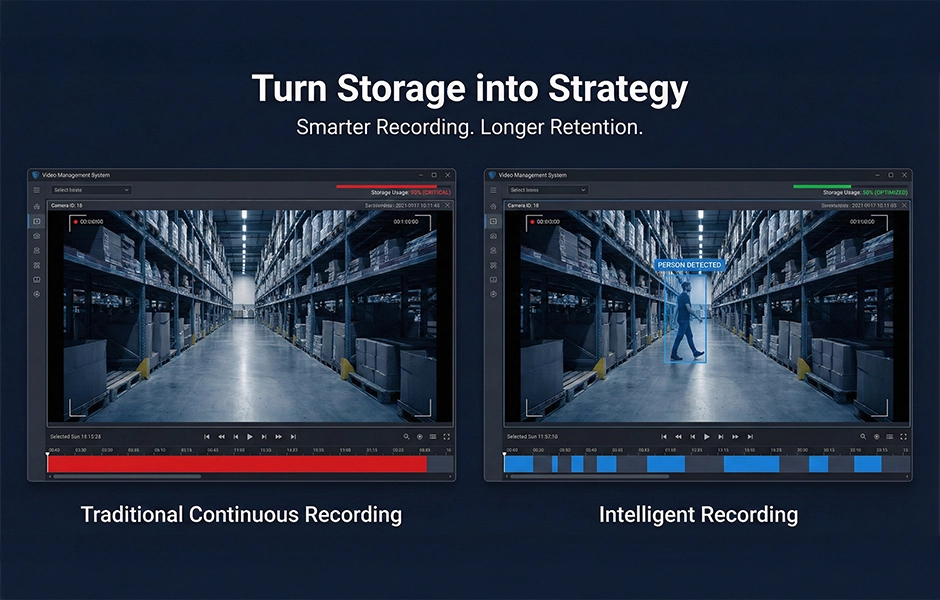
The RoS mandate demands a shift from treating video storage as a passive expense to approaching it as a strategic asset. Across the video surveillance system industry, modern systems are adopting advanced technologies like AI-powered encoding, dynamic GOP (Group of Pictures) control, object-based compression, and background-invariant recording—each designed to reduce storage consumption without compromising forensic clarity. These innovations ensure that only critical details (like faces, license plates, or moving objects) are captured at full fidelity, while redundant or static data is heavily compressed.
Matrix network cameras build on this foundation with proprietary techniques such as H.265+ compression, Smart Streaming, Region of Interest (ROI) encoding, and Adaptive Streaming, which intelligently reduce frame rates and bitrates during inactivity. Together, these technologies can slash storage costs by up to 50%, delivering high-retention, high-quality surveillance without the burden of bloated archives.
The “One-Logo” Imperative: Ending Integration Hell
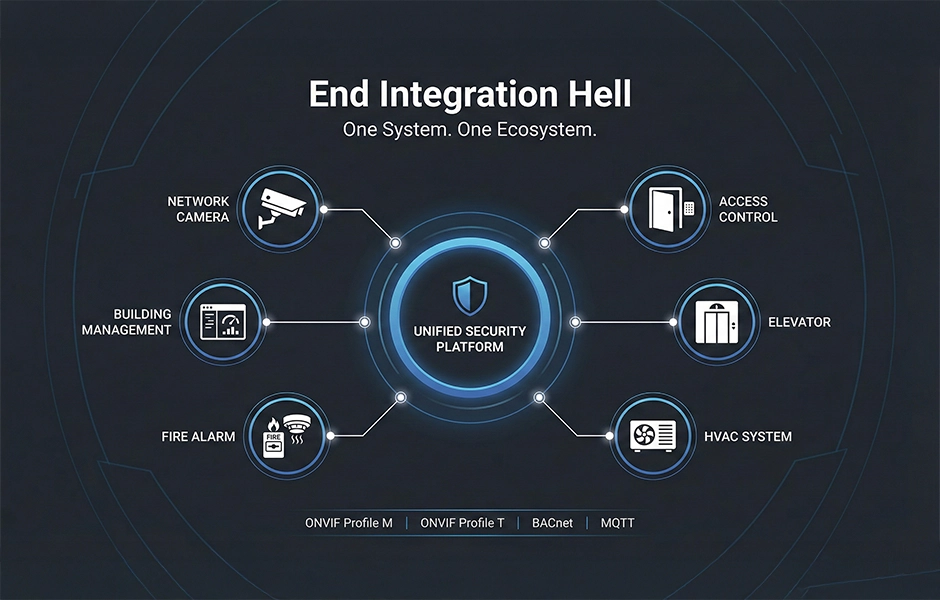
For years, enterprises endured the chaos of “Integration Hell”—managing disconnected systems for video, access, and facility controls that couldn’t communicate. In 2026, that fragmentation is no longer acceptable. Security infrastructure is now expected to act as a unified nervous system, natively connecting with HVAC, fire panels, elevators, and Building Management Systems (BMS) through standard protocols like BACnet and Message Queuing Telemetry Transport (MQTT). Features like emergency overrides and zone-based lockdowns must respond in sync across the entire facility—without the need for expensive middleware or complex custom scripting.
The shift toward this “Unified Ecosystem” is driven by Standardized Open Interoperability. The modern mandate is a system that strictly adheres to ONVIF Profile M (for AI metadata) and Profile T (for advanced streaming). This ensures that cameras are no longer proprietary “bricks,” but rather intelligent sensors capable of feeding rich metadata—such as object classification and thermal signatures—into any compliant Video Management Software (VMS) or Hybrid-Cloud dashboard. By prioritizing an API-first architecture, organizations can finally treat their security hardware as a flexible, long-term asset that evolves alongside their operational needs.
The Final Verdict: Choosing a Video Surveillance Partner, Not Just a Product
In 2026, the question isn’t “Which camera has the highest resolution?” It is “Which ecosystem guarantees business continuity?” As AI and cyber threats rise, the best video surveillance system is the one that evolves with you. It must turn storage from a cost into an asset. It must shift you from passive recording to active prevention. And most importantly, it must break the silos between security and facility operations.
The future belongs to the unified. Whether you are scaling to ten locations or a thousand, success requires an ecosystem engineered for growth. Matrix stands ready to deliver this. We ensure your security infrastructure is not just a tool—it is a strategic advantage. Connect with our experts now!