Imagine an orchestra where every musician plays from a different sheet of music; no matter how talented the individuals are, the result is chaos. The same applies to enterprise software ecosystems. In today’s digitally connected enterprise, operational silos are no longer just inefficient—they are a liability.
According to MarketsandMarkets, the global access control market is expected to reach $15.80 billion by 2030, growing at a CAGR of 8.3%. Simultaneously, organizations are investing heavily in HRMS, payroll automation, and IT infrastructure to streamline their workforce management. Yet, despite these investments, a critical gap persists: the lack of seamless integration between physical security systems and core business platforms. This disconnect creates compliance risks and operational blind spots. As organizations scale, achieving robust Access Control Integration is becoming a strategic priority rather than a mere technical upgrade.
Why do fragmented systems make access control integration essential?
Most organizations operate with multiple independent systems:
- HR systems manage employee lifecycle data.
- Payroll systems track attendance and compensation.
- IT systems control digital identity.
- Physical security systems regulate entry.
On paper, these platforms should work in sync; in reality, they rarely do. Traditional setups were not designed for interoperability. They rely on outdated architectures and limited APIs, making the integration complex and costly. The result is a fragmented ecosystem where employee onboarding requires manual data entry across different dashboards, and attendance data remains inconsistent. Ultimately, this lack of integration is a business continuity issue.
What are the key challenges the organizations face?
1. Data Silos and Redundancy
HR, payroll, and security often maintain entirely separate databases. This leads to a duplication of employee records and administrative overhead. When a new employee joins, HR updates their records, IT provisions digital access, and security teams manually configure physical access cards. Without proper Access Control Integration, these disconnected steps drastically increase the probability of human error.
2. Lack of Real-Time Synchronization
In a dynamic workforce, delays in data synchronization create serious risks. Consider employee exits: HR marks the employee as inactive, and payroll processes their final settlement. However, without Access Control Integration, the security system might still allow them physical entry into the building. This lag exposes organizations to insider threats and severe compliance violations.
3. Limited Compatibility with Legacy Systems
Many organizations still rely on legacy solutions that only support basic credentials like RFID or PINs. They lack modern capabilities and use proprietary communication protocols. These limitations severely block effective integration with modern HRMS or cloud-based IT systems.
4. Complex and Costly Processes
Custom workarounds to connect older systems often require middleware development, heavy vendor coordination, and continuous maintenance. For SMBs and SOHO environments, forcing Access Control Integration this way is neither scalable nor cost-effective.
5. Compliance and Audit Blind Spots
Disconnected systems make it incredibly difficult to generate unified reports. Without Access Control Integration, reconciling attendance with payroll or cross-referencing access logs with employee roles is a manual nightmare. This difficulty in generating accurate audit trails increases the risk of regulatory penalties.
Why is access control integration a strategic business priority?
Organizations that fail to address these issues face tangible, bottom-line consequences:
- Operational inefficiency: Manual processes slow down routine decision-making.
- Security vulnerabilities: Delayed access updates increase overall risk exposure.
- Poor employee experience: Unnecessary friction occurs during onboarding and daily operations.
- Inaccurate payroll processing: Misaligned attendance data quickly leads to employee disputes.
- Limited scalability: Siloed systems simply cannot adapt to business growth.
In a highly competitive environment, poor Access Control Integration directly impacts an organization’s productivity and profitability.
How to achieve seamless integration?
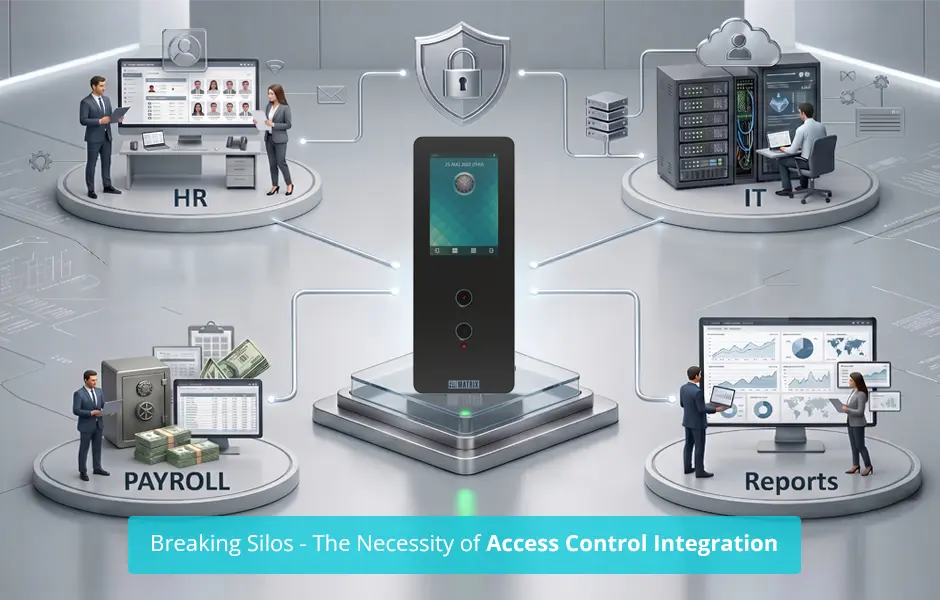
The market is moving rapidly toward API-driven ecosystems where physical security is tightly connected to business applications. Instead of functioning as standalone silos, modern setups act as a central intelligence layer connecting HR, Payroll, and IT infrastructure. To bridge the gap effectively, organizations should adopt a structured approach prioritizing these elements:
- Open API Architecture: Choose solutions that support standard communication protocols to allow seamless integration with third-party software like BMS, or Video Surveillance.
- Unified Data Management: Align HR systems as the master source of truth to ensure automatic synchronization across all platforms.
- Real-Time Logging: Modern systems can log up to 500,000 events, enabling accurate attendance tracking and seamless payroll syncing.
- Automated Lifecycle Management: Automate employee onboarding, role changes, and offboarding to ensure real-time updates through deep Access Control Integration.
- Multi-Dimensional Policies: Leverage user, location, and time parameters to align physical entry restrictions directly with HR-defined schedules.
The future: aligning security with business intelligence
Access Control Integration is no longer optional—it is a clear business differentiator. Organizations that successfully unify their physical security, HR, payroll, and IT systems gain real-time operational visibility, an enhanced security posture, and faster decision-making capabilities. This shift enables smarter, data-driven organizations.
As businesses scale and compliance requirements tighten, the structural inefficiencies of disconnected systems become a burden they can no longer afford. For those looking to future-proof their operations, the roadmap is clear: move away from fragmented systems and adopt a unified strategy.
Achieving this level requires platforms engineered specifically for modern connectivity. Solutions built on open architecture and web-based frameworks—such as Matrix access control solutions—bridge this exact gap seamlessly. By providing robust Access Control Integration right out of the box, they empower enterprises to align physical security directly with core business intelligence while maintaining flexibility and ease of deployment.