Employee attendance has a direct impact on productivity, compliance, and profitability, yet many Indian organizations still rely on outdated or loosely integrated systems to manage workforce movement and time records.
In India, irregular attendance and absenteeism of the workforce remain a persistent operational challenge, particularly in blue-collar and manufacturing segments, where attrition and absence rates have climbed alongside skills shortages and workforce instability. According to Deloitte’s Blue Collar Workforce Trends 2025 report, attrition in India’s blue-collar segment ranges from 5–7%, with absenteeism contributing to workforce unpredictability and productivity loss. Additionally, local implementations of biometric and AI-based attendance systems—such as city corporations in Hyderabad and Nagpur—have exposed attendance variances of up to 20 percentage points across zones and highlighted reporting delays ranging from 12 to 21 minutes on average. These operational inefficiencies not only disrupt schedules and delivery targets but also inflate payroll discrepancies and compliance risks across industries.
Globally, access control systems are growing rapidly as organizations invest in workforce accountability technologies, and according to a report by Research and Markets, the access control market in India alone is projected to expand from roughly ₹81.8 billion in 2024 to over ₹243 billion by 2033 at a CAGR exceeding 12%, driven by demand for secure attendance tracking and integrated workforce management.
The Link Between Employee Attendance and Access Control
Traditional employee attendance systems often operate in isolation. They record punch-in and punch-out data but fail to validate whether the right individual is physically present in the right zone at the right time. This creates gaps: buddy punching, unauthorized access, and inaccurate attendance records.
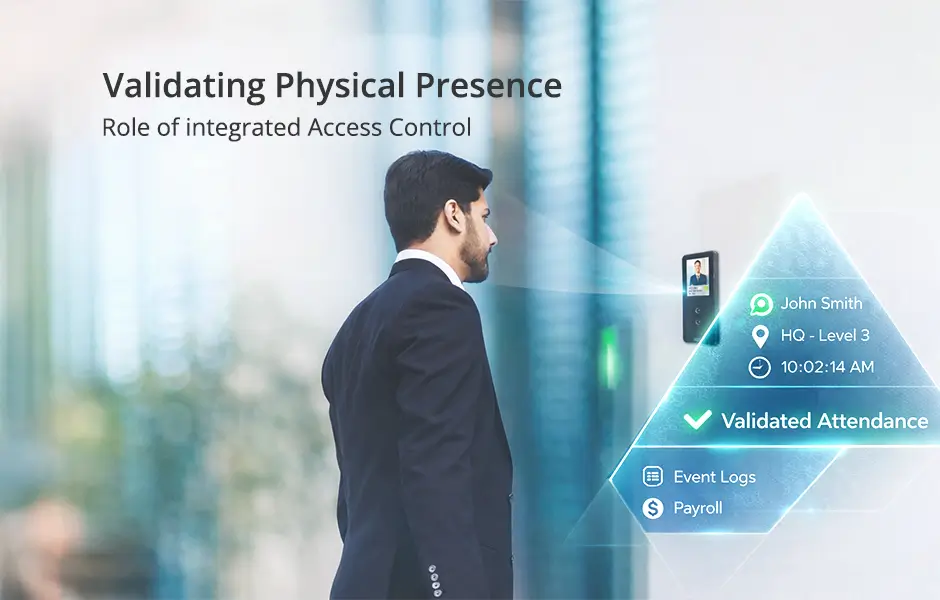
Modern access control closes these gaps by combining identity verification with physical entry management. When entry to a facility, floor, or restricted area is authenticated through biometric credentials, mobile credentials, or smart cards, attendance data becomes reliable. It moves from assumption-based logging to event-driven validation.
Three-dimensional access policies—based on user, location, and time—ensure that workforce movement aligns with defined business rules. For example, an employee can be granted access only to a specific department during approved shift hours. This directly improves employee attendance discipline and supports accurate workforce management reporting.
Eliminating Buddy Punching and Proxy Attendance
One of the most persistent challenges in employee attendance management is proxy attendance, where one employee clocks in on behalf of another. This practice distorts payroll data and erodes accountability.
Advanced access control systems address this through biometric authentication such as fingerprint or face recognition, as well as mobile-based credentials. By tying physical presence to unique biological or device-based identifiers, organizations eliminate the risk of duplicate or shared credentials. Features like Anti-Passback further strengthen controls by preventing re-entry without a registered exit, thereby ensuring accurate occupancy tracking.
The result is deterministic employee attendance data that feeds directly into payroll and HR systems, reducing disputes and administrative overhead.
Enhancing Workforce Management Through Real-Time Visibility
Workforce management is not just about recording attendance; it is about visibility and control. Real-time monitoring of entry and exit events allows managers to understand who is present in a facility, which zones are occupied, and whether access violations are occurring.
Centralized dashboards, live event logs, and automated notifications enable immediate response to exceptions. For example, if an employee attempts to access a restricted zone outside authorized hours, the system can trigger alerts. This proactive approach transforms access control from a passive gatekeeper into an active management tool.
Features such as “Who’s-In” reporting support emergency evacuation planning by instantly identifying all individuals present within a specific area. Occupancy control mechanisms help regulate the number of people in shared spaces, improving safety and resource utilization. Together, these capabilities elevate workforce management from reactive record-keeping to proactive oversight.
Integration with Payroll and HR Systems
Disconnected systems create inefficiencies. When employee attendance data must be manually transferred to payroll software, errors are inevitable. Open APIs and integration capabilities allow access control systems to connect directly with time-attendance and payroll platforms.
This integration ensures that validated entry and exit events automatically generate accurate working-hour records. It streamlines salary calculations, overtime tracking, and compliance reporting. In regulated industries such as healthcare, manufacturing, and BFSI, this level of integration also supports audit readiness.
Additionally, integration with fire alarms, video surveillance, and building management systems enhances operational synergy. For example, time stamping with video snapshots provides visual proof of entry or exit, strengthening compliance and security audits.
Simplifying Deployment for SMB and SOHO Organizations
Historically, sophisticated access control systems were associated with large enterprises due to complex cabling, bulky centralized panels, and server dependencies. However, small and medium businesses also face workforce management challenges and require enterprise-grade security without operational complexity.
IP-based architecture and Power over Ethernet (PoE+) simplify installation by leveraging standard CAT6 cabling and centralized power. Distributed controllers eliminate single points of failure and reduce maintenance requirements. Built-in web-based configuration removes the need for dedicated servers or specialized software.
This plug-and-play model shortens deployment cycles and reduces the total cost of ownership. It makes advanced employee attendance and workforce management capabilities accessible to organizations with 5 to 1,000 users, whether operating from a single floor, a single building, or multiple controlled zones.
Supporting Compliance and Safety
Workforce management also intersects with compliance and safety. In sectors such as pharmaceuticals, data centers, and R&D facilities, controlled access is mandatory. Features like the 2-Person Rule, First-In User, Dead-Man Zone, and Door Interlocking ensure that sensitive or hazardous areas are accessed according to defined safety protocols.
Guard Tour functionality enforces patrol routines, enhancing site security. Access Routes regulate movement through predefined paths, reducing the risk of loitering in restricted zones. These features not only strengthen security but also enhance operational discipline.
By embedding such controls into the employee attendance framework, organizations create a transparent and compliant work environment. Workforce management becomes aligned with regulatory requirements and risk mitigation strategies.
Future-Proofing Workforce Infrastructure
As organizations adopt hybrid work models and mobile-first operations, workforce management systems must evolve. Mobile credentials, Bluetooth, NFC, and QR-based access methods provide flexibility without compromising security. Encrypted communication protocols protect against cyber threats, ensuring that attendance data remains secure.
Scalability is another critical factor. The ability to manage thousands of users and hundreds of doors from a single panel allows businesses to expand without redesigning their infrastructure. Backup and restore capabilities safeguard configuration data and event logs, minimizing downtime during disruptions.
Forward-looking organizations view access control not merely as a security investment but as a strategic workforce management asset.
Driving Operational Excellence with the Right Technology
Improving employee attendance and workforce management requires more than policy enforcement. It demands a technology backbone that integrates identity verification, physical access, real-time monitoring, and system interoperability.
Solutions designed specifically for small and mid-sized organizations now deliver enterprise-grade capabilities without the burden of complex infrastructure. Distributed IP architecture, PoE-powered controllers, biometric and mobile credentials, three-dimensional access policies, and seamless integration with payroll and surveillance systems collectively redefine how organizations manage their workforce.
Matrix has engineered its access control portfolio to address these exact requirements. With an all-in-one architecture, support for new-age credentials, built-in web-based management, open integration capabilities, and scalable design, Matrix solutions align directly with the needs of organizations seeking to strengthen employee attendance and optimize workforce management.
For businesses aiming to reduce absenteeism, eliminate attendance fraud, enhance compliance, and achieve real-time workforce visibility, adopting a modern access control framework is no longer optional. It is a strategic move toward operational excellence—and the right technology partner can make that transition seamless and future-ready.