
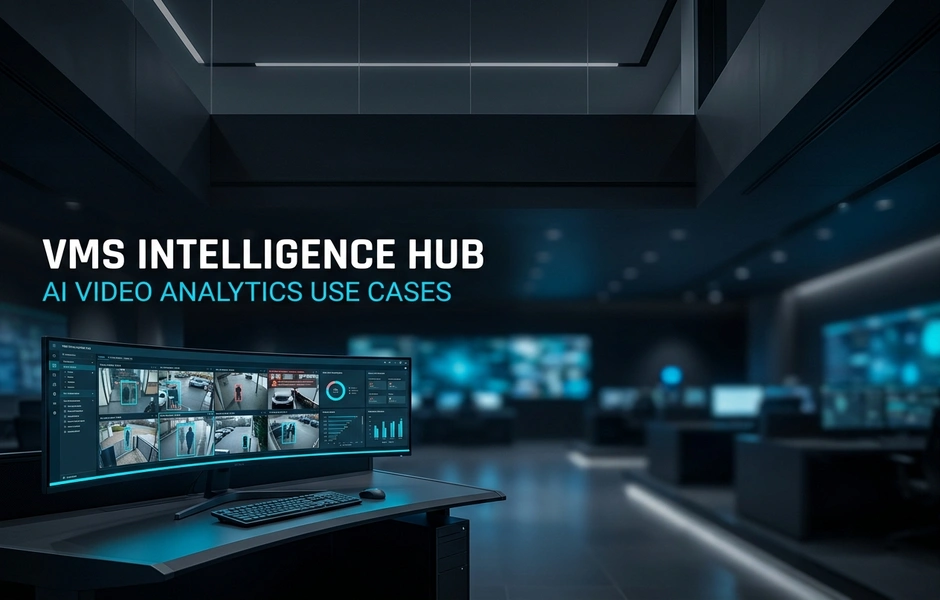
Old video surveillance setups record endless hours of footage. Overworked security teams rarely check these videos until after an incident happens. Relying on passive monitoring causes fatigue, missed breaches, and slow searches. Manual reviews raise guard costs and leave teams reactive across nationwide facilities.
Modern video management software with artificial intelligence solves this problem. Advanced AI algorithms convert camera feeds into structured, searchable data in real time. This shift turns a basic recording system into a central security hub.
Security leaders face severe labor shortages in guard staffing. AI analytics help by automating perimeter intrusion detection, loitering alerts, and crowd management. Security teams can protect hospitals, corporate facilities, logistics centers, and remote fields without adding guards. Flexible system setups protect civil liberties while meeting privacy laws.
Your organization can turn passive recording hardware into a proactive intelligence platform. This platform lowers risk, cuts costs, and simplifies compliance. Read on to explore practical scenarios that modernize security operations today.
Why Is Traditional Passive Surveillance Failing Modern Enterprise Security?
Passive surveillance fails because operators cannot watch dozens of screens at once without fatigue. Mental overload causes security staff to miss live breaches. Older cameras only record incidents for later review. This leaves sites exposed to theft, trespassing, safety hazards, and property damage. Manual monitoring turns expensive camera networks into passive archives instead of active protective systems. Passive setups do not scale across large sites, regional campuses, or remote facilities where guard patrols are hard to run.
Modern security needs continuous automated threat detection and real-time awareness. Intelligent software bridges this gap by filtering live video, identifying security events, and alerting response teams fast. Passive systems cannot keep up with complex modern risks.
What Is the Real Operational Cost of Passive Video Recording?
Relying on passive video recording creates clear inefficiencies:
- Old System: Guards manually search recorded footage after incidents, wasting valuable time.
- Modern System: Video metadata indexing lets operators search specific behaviors instantly across all connected cameras.
Manual video reviews waste money and offer zero protection during live breaches. Staff waste many hours after every major incident. Reactive monitoring increases costs through unmanaged liability, property damage, and delayed responses. Old recordings leave facilities exposed.
How Does Video Analytics Bridge the Gap Between Recording and Action?
AI-driven systems turn raw video feeds into actionable real-time alerts through three steps:
- Filter False Alarms: AI event classification ignores noise like weather, light changes, or animal motion.
- Index Live Events: Algorithms classify people, vehicles, and behaviors to create real-time metadata continuously.
- Trigger Guard Action: Instant alerts notify guards, enabling fast action before threats escalate.
Following a unified VMS analytics guide lets organizations deploy enterprise video analytics smoothly. Unifying video surveillance, access control, and communications forms a central security hub. Platforms like Matrix simplify triage across multi-site operations.
Replacing passive recording with active video intelligence saves operator hours and reduces operational risks. Review practical video analytics use cases to modernize enterprise security efficiently.
How Do Video Analytics Transform Your VMS into a Security Intelligence Hub?
Video analytics transform a video management system (VMS) by turning passive footage into real-time intelligence. Artificial intelligence analyzes video feeds automatically instead of forcing guards to watch screens continuously. It detects risks, flags anomalies, and routes alerts to operators fast.
This change solves severe challenges like nationwide guard shortages across large campuses. By unifying video surveillance, access control, and communications, systems become proactive operational hubs.
This shift relies on advanced artificial intelligence systems and structured data indexing.
| Old System | Modern Security Intelligence Hub |
| Passive video recording | Real-time automated threat detection |
| Continuous manual screen watching | Incident-driven alert workflows |
| Isolated camera channels | Unified video, access, and comms |
What Core AI Technologies Power Modern VMS Intelligence?
Modern enterprise video analytics rely on deep learning object classification. Traditional motion detection triggers false alarms when light shifts, rain falls, or trees move. Deep learning models evaluate shapes and movement patterns to classify subjects accurately.
- Humans: Detects intruders, loitering, and restricted zone breaches.
- Vehicles: Classify trucks, cars, and traffic direction.
- Animals: Filter out non-threatening wildlife motion.
Systems balance processing between edge devices and central servers. Edge processing reduces network bandwidth demands and lowers server latency. Central processing links complex events across multi-site enterprise deployments. Platforms like Matrix integrate these layers into an open platform. Unlike single-vendor setups like Hikvision or Dahua, open platforms work with existing cameras without vendor lock-in.
How Does Video Metadata Indexing Accelerate Forensic Video Search?
Metadata indexing converts video frames into searchable text descriptions. Every frame is tagged automatically with specific details in real time.
Key metadata details include:
- Visual features: Target clothing color, vehicle type, and make.
- Identification: License plate numbers and facial details.
- Behaviors: Dwell time, direction, and queue length.
Security teams run complex queries across hundreds of camera feeds within seconds. Instead of reviewing recorded video for days, operators follow a simple process:
- Input known search terms like red sedan or blue jacket.
- Filter results by specific time frames and camera zones.
- Export verified incident clips for quick evidence submission.
This tool simplifies searches across remote utilities and busy retail locations. Exploring video analytics use cases helps teams isolate incidents quickly.
Using a clear VMS analytics guide improves threat detection and speeds up forensic searches. Upgrading your platform turns raw video into useful operational intelligence. Next, examine practical setup workflows for your facility.
What Are the Most Practical Video Analytics Use Cases Across Key Sectors?
The most practical video analytics use cases cover perimeter protection, business operations, and specialized sector tasks. Modern organizations use AI software to turn passive camera feeds into proactive intelligence. In critical infrastructure, virtual boundary systems detect intrusions across large sites without raising guard costs. In retail, foot-traffic analysis improves staff schedules and store layouts. In logistics and healthcare, automated alerts enforce safety rules and monitor vulnerable patients. Using these systems helps enterprises manage guard shortages efficiently. Organizations automate routine monitoring while maintaining high operational awareness across all locations.
Old System vs. Modern System:
- Old System: Guards watch static screens, leading to missed events and slow responses.
- Modern System: AI identifies actionable threats automatically, creating real-time alerts for operators.
How Do Perimeter Intrusion Detection and Geo-Fencing Prevent Security Breaches?
Remote sites face constant physical threats. Relying on guards for vast properties is costly and inefficient. It works, but it does not think.
Perimeter intrusion detection creates smart digital barriers. AI algorithms enforce virtual boundaries using key features:
- Line Crossing: Triggers instant alerts when unauthorized people or vehicles cross tripwires.
- Virtual Geo-Fencing: Enforces strict boundaries around high-security zones.
- Loitering Detection: Identifies suspicious people remaining near fence lines too long.
This technology protects remote infrastructure like Texas oil fields, Midwestern wind farms, and Southwestern solar facilities. Thermal imaging with vehicle classification filters out wind and wildlife to minimize false alarms.
Step-by-Step Security Workflow:
- AI detects virtual boundary line crossing.
- The analytics engine classifies objects as vehicles or people.
- The system triggers immediate alerts to central operators.
How Do People Counting and Heat Mapping Drive Operational Business Intelligence?
Managing physical venues without footfall data creates bottlenecks. Unplanned rushes lead to long lines, frustrated buyers, and lost revenue.
Integrated VMS analytics turn video hardware into operational systems. Retail centers use queue management analytics and heat maps to track customer movement. Managers adjust staff schedules and optimize store layouts based on dwell times. Retailers also monitor curbside pickup zones in suburban areas to streamline customer handoffs.
Public venues and transit hubs rely on occupancy tracking to ensure safety compliance. AI systems calculate crowd density at busy entrances in dense Northeast and West Coast cities.
Key Business Intelligence Benefits:
- Optimizes employee schedules based on peak foot-traffic hours.
- Reduces checkout wait times through automated queue thresholds.
- Prevents overcrowding in high-density public spaces.
How Do Specialized Analytics Support Healthcare, Logistics, and Public Safety?
Specialized environments need tailored surveillance systems to enforce safety and lower operational risks. Standard monitoring fails to meet niche compliance needs.
In healthcare facilities, AI video analytics monitor patient safety while supporting privacy masking. Patient elopement detection alerts staff when at-risk patients wander near exits. Fall monitoring detects sudden drops, enabling rapid response.
Logistics hubs, construction sites, and plants use specialized AI for operational safety:
- License Plate Recognition (LPR/ANPR): Tracks logistics vehicles entering shipping bays.
- PPE Compliance Monitoring: Verifies hardhats and safety vests in hazardous work zones.
- Abandoned Object Detection: Flags unattended luggage or items in transit hubs.
Following a VMS analytics guide helps enterprises select open platforms like Matrix. Integrating video surveillance, access control, and communications delivers enterprise video analytics without vendor lock-in.
Ready to transform your passive cameras into a security intelligence hub? Upgrade your VMS deployment today.
How Can Enterprises Overcome Labor Shortages and Compliance Challenges?
How Do Automated Analytics Solve Security Guard Staffing Shortages?
Enterprises face severe security staffing shortages nationwide. Manual monitoring is costly, inefficient, and prone to human fatigue. AI-driven video analytics solve this crisis by automating incident triage and filtering routine video feeds. Instead of hiring more guards, organizations use intelligent software to flag critical threats in real time. This proactive approach speeds up incident response.
This approach transforms security operations across large environments:
- Automated Incident Triage: Focuses guard attention solely on verified perimeter breaches or loitering.
- Human-in-the-Loop Workflows: Prioritizes severe alerts so smaller teams safely protect university campuses and medical centers.
- Operational Scalability: Multiplies guard efficiency without increasing total headcount or payroll costs.
Old System vs. Modern System:
- Old System: Guards watch dozens of passive camera screens continuously, missing critical incidents.
- Modern System: AI identifies actionable events, sending immediate alerts to on-duty personnel.
What Standard Baseline Should Enterprise Buyers Demand in an Analytics VMS?
Why Are Open Interoperability and Cybersecurity-by-Design Non-Negotiable?
Enterprise buyers must demand open architecture, strict compliance, and cybersecurity-by-design from any modern video platform. A complete VMS analytics guide helps organizations evaluate these essential technical standards.
- Compliance Assurance: Full NDAA and GDPR compliance ensures strict rule adherence while protecting sensitive personal data.
- Open System Integration: Open frameworks enable third-party camera integration without restrictive vendor lock-in.
- Threat Prevention: End-to-end hardware-software integration eliminates critical security vulnerabilities across networks.
Choosing open, cyber-secure platforms guarantees multi-vendor hardware compatibility across distributed campuses. It also prevents costly hardware replacement cycles when expanding security operations.
How Does a Unified VMS and Access Control Architecture Lower TCO?
Fusing intelligent video surveillance with access control, time-attendance, and sensors lowers total cost of ownership (TCO). Managing these security layers within one central platform simplifies daily operations.
Old System vs. Modern Unified System:
- Old System: Disconnected software silos increase complexity and maintenance costs.
- Modern System: Centralized policy control reduces manual work and speeds up incident triage.
Key financial advantages include:
- Reduced Licensing Fees: Consolidating systems lowers software overhead across complex multi-site facilities.
- High MTBF Equipment: Enterprise-grade hardware minimizes maintenance downtime and replacement costs.
- Streamlined Security Labor: Automated workflows cover large sites without expanding guard headcount.
You gain a scalable security intelligence hub that optimizes long-term capital spending. Unlike camera-centric providers, Matrix offers unified software, access control, and native hardware. This lowers TCO while supporting critical video analytics use cases. In the next section, we outline practical step-by-step deployment strategies.
Conclusion
Traditional passive video surveillance leaves modern enterprise facilities exposed to constant risk. Human operators experience severe cognitive fatigue when monitoring continuous camera screens. Manual video reviews cause missed live breaches, delayed responses, and high guard costs across enterprise sites.
Integrating artificial intelligence transforms legacy VMS hardware into a central security intelligence hub. Deep learning algorithms convert raw video feeds into structured, searchable metadata in real time. Security personnel can automate perimeter intrusion detection, track crowd density, and run instant forensic searches across multi-site operations. Corporate campuses, remote utility fields, and healthcare facilities stay protected without adding guards. Unified platforms ensure strict privacy compliance while simplifying daily threat management.
Shifting from reactive video recording to continuous threat detection dramatically lowers costs and eliminates wasted operator hours. Modern analytics convert passive camera networks into active protective assets that prevent security incidents before they escalate. Integrated systems also simplify threat triage across distributed facilities.
Your next operational step is clear. Review your current security setup and identify high-priority vulnerabilities. Deploy proven video analytics use cases to turn passive recording hardware into a proactive intelligence platform today. Upgrading your VMS bridges the gap between simple recording and decisive security action.
Frequently Asked Questions
What is the difference between edge analytics and server-based VMS analytics?
Edge analytics process video directly on IP cameras to save network bandwidth. Server-based VMS analytics run complex deep-learning models centrally across multiple camera feeds. Combining both creates a unified security hub that balances local edge processing with central cross-site reporting.
Can I deploy video analytics on my existing camera infrastructure?
Yes, open enterprise video management systems integrate with existing third-party cameras. You can add AI video analytics, license plate recognition, and people counting without replacing hardware. This software-led approach lowers total cost of ownership while turning old surveillance into proactive intelligence.
How do AI video analytics reduce false alarms in outdoor environments?
Traditional motion detection triggers alerts from moving shadows, wind, rain, or small animals. AI-powered video analytics use deep learning to classify specific targets like humans and vehicles. This accurate filtering minimizes false alarms, reduces fatigue, and speeds up incident triage for remote facilities.
How does metadata indexing speed up security investigations?
Instead of reviewing hours of recorded video, intelligent video surveillance indexes key visual traits into searchable metadata. Operators can query specific details such as vehicle color, license plates, or loitering behaviors. Forensic video search turns hours of manual review into instant results.