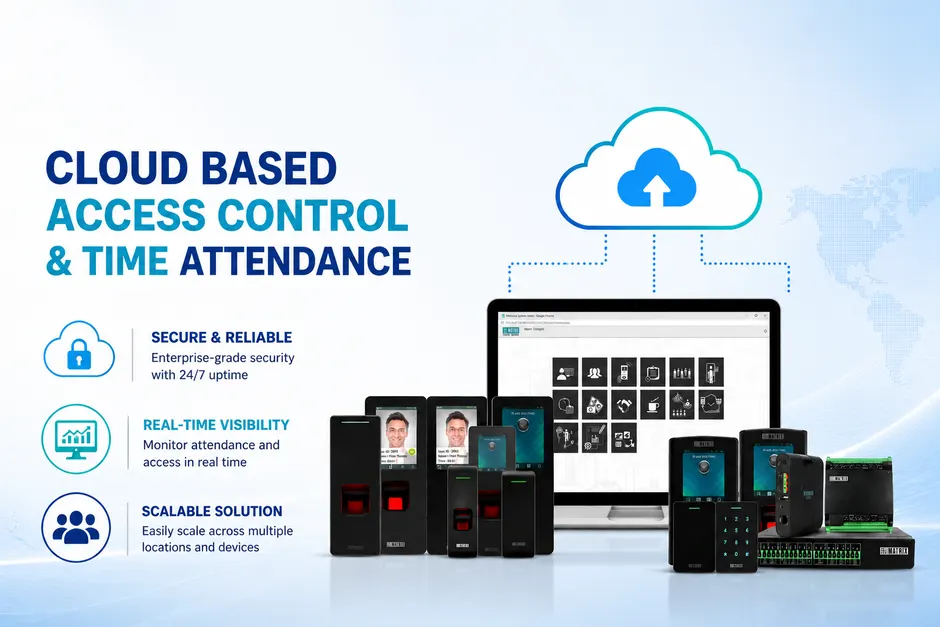
Traditional on-premise attendance and access systems still work, but they slow you down. HR, admin, and security teams battle manual entries, fragmented data, and rising compliance risk, especially across many locations. A cloud based time and attendance system with modern access control and time attendance software is now the practical way forward. This guide outlines 7 clear business reasons to switch to cloud-based security solutions.
What Is a Cloud Based Time and Attendance System?
A cloud based time and attendance system links on-site devices to secure software in the cloud. Readers, controllers, and biometric terminals sit at your offices. The central “brain” runs online.
Old system vs. modern system:
- On-premise: servers in each site, manual updates, limited visibility.
- Cloud: one platform for all locations, real-time data, automatic upgrades.
You gain simpler control of people and doors, fewer IT issues, and secure, compliant access control and time attendance software as a standard feature.
Reason 1: How Do Flexibility and Scalability Help Your Business Grow?
Old systems work, but they force fixed rules and local servers. Any change needs IT effort, new hardware, and long rollouts.
Modern access control and time attendance software adapts as you grow.
- Configure rules by site, role, or project.
- Add branches or devices without new servers.
- Support seasonal or project teams across locations.
You get faster changes, smoother rollouts, and a cloud based time and attendance system that grows with your business.
Reason 2: How Does the Cloud Improve Security and Compliance?
Many still fear putting access and attendance data in the cloud. That fear is often outdated.
Old system vs. modern system:
- On-premise SME server: shared passwords, rare backups, slow patches.
- Cloud stack: encryption, multi-factor login, regular backups, disaster recovery, frequent security updates.
Most platforms align with GDPR and similar data protection norms.
You lower breach risk, simplify audits, and gain security by design when you choose a compliant cloud based time and attendance system.
Reason 3: Why Does Real Time Monitoring Matter for Multi Location Control?
Old system vs. modern system:
- Old: delayed reports, manual exports, blind spots between sites.
- Modern: live dashboards, instant alerts, unified views across locations.
A cloud based time and attendance system shows entries, exits, and exceptions as they happen. You see every branch from one console.
You respond faster to incidents, reduce policy breaches, and gain real control of a multi location access control system.
Reason 4: How Does Cloud Uptime Increase Operational Efficiency?
Old system vs. modern system:
- Old: one local server fails, gates freeze, queues build, manual fixes start.
- Modern: distributed cloud, built-in redundancy and failover, 24×7 availability.
Reliable access control and time attendance software keeps shifts flowing and logs accurate. Operations stay predictable, even when single devices fail.
You face fewer interruptions, less fire-fighting, and smoother workdays at every site.
You lower total cost over time and simplify budgeting. Your access control and time attendance software grows without surprise hardware bills.
Why Does Anywhere, Anytime Access Change Daily Operations?
Old system: HR and managers must sit in the office to view logs or approve requests.
Modern cloud based time and attendance system: they log in from any browser or mobile app.
- HR tracks attendance and shifts on the move.
- Managers approve leaves and overtime from the field.
- Admins control doors across sites in one view.
When offices close or networks fail, work still continues. Data is not tied to one server. Backups and disaster recovery sit with the provider.
You gain faster decisions, better support for remote teams, and operations that keep running during local disruption.
How Does Integration With HR and Payroll Simplify Workflows?
Old system: HR rekeys attendance into payroll, leave, and ERP.
Modern access control and time attendance software: one source of truth feeds every system.
- Attendance flows straight into payroll, cutting edits and disputes.
- Leave, overtime, and shift data sync with HR and ERP in near real time.
You get accurate payouts, lean HR operations, and stable integrations that are supported end to end.
How Should You Evaluate a Cloud Based Access Control Partner?
Ask these questions before you commit to any cloud based time and attendance system:
- Do they offer one unified platform for doors, attendance, and shifts?
- Is security built in from day one, with compliance and audits?
- Can they prove uptime, hardware reliability, and strong in-house R&D?
- Is support responsive for always on, multi site operations?
You de-risk a long-term investment when you use strong engineering depth as your benchmark.
Frequently Asked Questions
What is the difference between cloud vs on premise time attendance?
Cloud based time and attendance runs in a remote data center. You access it via browser or app. On premise software runs on your own servers. Cloud solutions use subscriptions, scale faster, and reduce hardware and IT costs. The vendor handles updates and maintenance. You also get easier remote access for HR and managers.
Is a cloud based time and attendance system secure enough for employee data?
A serious cloud access control vendor uses strong encryption for data. They support secure logins, multi factor authentication, and detailed access rights. Regular backups and disaster recovery protect records from loss. Many providers follow common security and privacy standards. Always review their certifications and security practices before signing.
How does HR and payroll integration with access control actually work?
Employees clock in using cards, mobile credentials, or biometrics. The cloud system turns raw punches into worked hours and attendance records. Approved timesheets then flow into HR and payroll software. This can use an API link or secure data export. The goal is to remove manual entry, reduce errors, and speed payroll.
Can a cloud time attendance solution handle multi location access control system needs?
Yes, a cloud platform suits multi site access control. All doors, readers, and time clocks connect to one central system. You can define role based access rules across sites or per location. Managers see real time attendance and alerts from every branch. This makes it easier to enforce consistent policies and audits.
What should I check before switching to a cloud based access control platform?
Review the provider’s uptime history and data center setup. Ask about security controls, certifications, and legal compliance in your region. Confirm who owns your data and how you can export it. Check how often they update features and their roadmap. Test support response, onboarding help, and integration options with your HR and payroll tools.
What Does This Shift Mean For Your Business?
Old model: hardware-heavy, site-bound, hard to scale.
Modern model: a cloud based time and attendance system that adapts as you grow.
Treat access control and time attendance software as a strategic platform. Review your current setup and speak with experts before your next upgrade.
Conclusion
Switching from on-premise to a cloud based time and attendance system is now a core business decision. Cloud platforms give real time visibility, stronger security, and better uptime across every site. They cut manual work through HR and payroll integration and support multi location access control from one console. Your next step is to review your current setup, compare cloud vs on premise time attendance, and speak with expert providers before you upgrade.