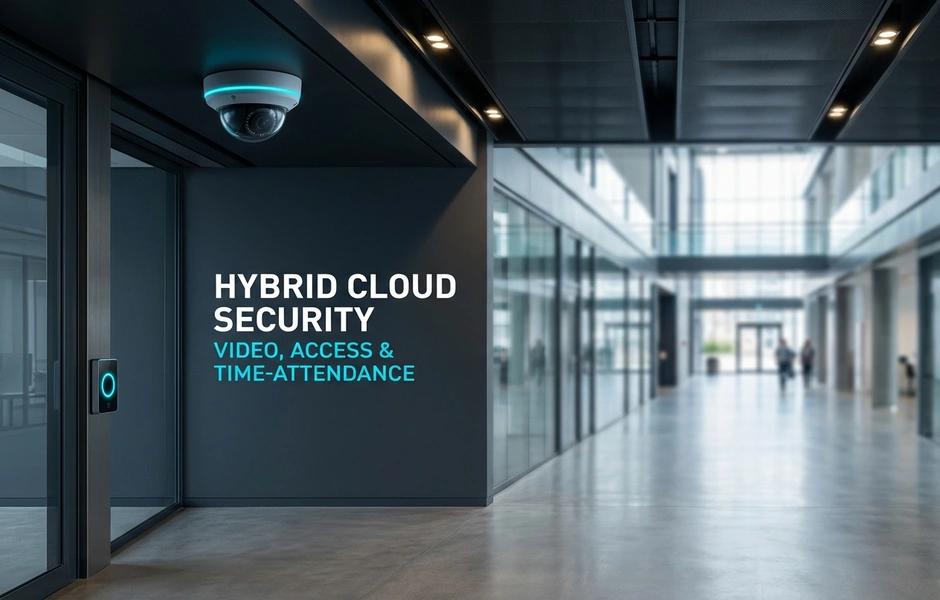
Managing fragmented physical security systems across video surveillance, access control, and time-attendance creates costly operational silos and vulnerability gaps. Security teams waste hours managing separate software platforms, manual log reconciliations, and mismatched user credentials across facility locations.
Choosing between cloud vs on-prem video surveillance leaves enterprises trapped in a tough dilemma. Pure cloud setups create massive bandwidth demands and high monthly subscription expenses. Meanwhile, legacy local hardware risks single points of failure, data loss, and costly multi-site maintenance.
Adopting a unified hybrid framework offers the ideal path forward. It combines local edge processing reliability with global cloud orchestration and consistent policy enforcement. This balanced design protects critical site operations while simplifying corporate administrative control.
Here is how hybrid system design transforms your physical security posture:
- Legacy Systems: Fragmented hardware, heavy bandwidth demands, local data loss risks.
- Modern Hybrid Architecture: Edge processing, cloud orchestration, zero network outage downtime.
A well-designed architecture unifies hardware, edge processing, and cloud management without sacrificing compliance or uptime. Local door controllers and recorders maintain fast site operations during internet disruptions. Meanwhile, the cloud environment centralizes user permissions, firmware updates, and automated audit reporting across all branches seamlessly.
What This Means for You:
You streamline daily operations, safeguard local facilities against WAN outages, and eliminate redundant IT infrastructure across your enterprise environment. You gain complete visibility without compromising local physical security resilience.
In the next section, we explore the core structural layers required to deploy a resilient, highly scalable hybrid security architecture across all locations.
Why Is Traditional Physical Security Failing Modern Enterprise Operations?
Traditional physical security fails modern enterprises because disconnected, site-by-site legacy systems create operational friction and major security blind spots. Managing separate hardware platforms across locations increases software maintenance overhead and delays incident response times across sites. Unintegrated time-attendance and access control systems cause frequent payroll errors and unmonitored physical security policy breaches.
Legacy System vs Modern Hybrid System:
- Legacy System: Isolated software, manual maintenance, bandwidth bottlenecks, and payroll errors.
- Modern Hybrid Architecture: Centralized management, local edge resilience, integrated access policies, and automated compliance.
A hybrid cloud physical security strategy solves these vulnerabilities by connecting local edge hardware with unified cloud management.
What Are the Hidden Risks of Pure Cloud vs. Pure On-Premises Systems?
Evaluating cloud vs on-prem video surveillance and access platforms reveals distinct trade-offs:
- Pure Cloud Systems: Rely heavily on constant WAN connectivity. Network outages drop remote video feeds and disable cloud management. Heavy video streaming strains site bandwidth.
- Pure On-Premises Systems: Provide local resilience but suffer from high management overhead. IT teams must manually update patches across scattered locations. Local hardware failure leads to irreversible data loss.
A hybrid cloud security architecture balances both models. Edge recording keeps cameras and local door controllers operational during WAN failure. Meanwhile, cloud orchestration provides centralized dashboards, long-term storage, and remote access. To comply with nationwide labor and privacy regulations, organizations keep biometric data and employee PII on-premises while using the cloud for anonymized reporting.
Why Must Video Surveillance, Access Control, and Time-Attendance Converge?
Running multi-vendor point solutions creates data silos and operational delays. Modern enterprises require a unified physical security platform where video surveillance, access control, and time-attendance operate together seamlessly.
Convergence delivers clear operational advantages:
- Faster Incident Investigations: Linking access card events directly to video footage speeds up audit trails.
- Instant Threat Response: Terminating an employee in the HR system automatically revokes access badges and updates attendance tracking.
- Accurate Payroll Records: Matching biometric access events with time-attendance logs prevents buddy punching and payroll miscalculations.
Unlike single-function tools from Hikvision or Axis, Matrix Comsec delivers a natively unified hybrid architecture. It natively integrates video surveillance, access control, and time-attendance on a single cloud platform.
What This Means for You:
You eliminate vendor sprawl, ensure local site resilience during outages, and significantly reduce ongoing administrative overhead. Next, we will examine the essential architectural layers needed to build a scalable hybrid framework.
What Is a Hybrid Cloud Physical Security Architecture?
A hybrid cloud physical security architecture combines local edge hardware with centralized cloud orchestration into a unified security ecosystem. In this model, physical devices process real-time security events locally while cloud software handles long-term storage, remote management, and analytics.
Traditional enterprise setups force a hard choice: cloud vs on-prem video surveillance and access control. Hybrid systems eliminate that trade-off entirely. Local hardware records high-definition video and verifies access credentials immediately. Meanwhile, cloud orchestration provides centralized management across nationwide facilities without exhausting local network bandwidth.
Old System vs. Modern System:
- Old System (Legacy On-Prem): Uses isolated local servers, fails completely if servers crash, and requires manual site-by-site software updates.
- Modern System (Hybrid Cloud): Employs distributed edge intelligence, provides local failover resilience, and enables centralized real-time cloud control.
How Does Edge Recording with Cloud Management Work?
Edge recording with cloud management ensures continuous operations during unexpected network outages. Local NVRs, IP cameras, and door controllers record video footage and store event logs directly on site. If an internet blackout hits, your physical security system continues operating without missing a single event.
- Local Capture: Edge devices record raw video and process access requests locally in real time.
- Offline Buffering: On-prem NVRs store all video files and event logs during temporary WAN failures.
- Automatic Sync: Cloud orchestration uploads metadata, health status, and analytics summaries once connectivity restores.
Centralized dashboards receive summarized video events and system health metrics instantly upon reconnection. This keeps central security teams fully informed while preventing WAN bandwidth congestion across corporate networks.
What This Means for You:
Your sites stay fully secure offline, and your IT network stays fast online.
How Do You Balance On-Premises Resilience with Centralized Control?
Balancing local resilience with central control requires dividing operational duties between local hardware and cloud management software. Local door controllers validate user credentials and process door unlock commands in milliseconds. They operate independently of WAN stability, ensuring fast access control decisions at every facility entrance.
Simultaneously, enterprise security administrators use the central cloud management platform to push global policy changes across nationwide facilities.
- Instant Updates: Deploy global access rights, user permissions, and credential revocations across all sites in seconds.
- Automated Maintenance: Schedule firmware updates and health checks remotely without sending technicians to physical locations.
- Emergency Protocols: Trigger nationwide lockdown procedures instantly across all connected sites during high-level threat events.
Unlike video-centric options from Hikvision or Axis, Matrix Comsec unifies video, access control, and time-attendance within one balanced architecture.
What This Means for You:
You gain instant local response times alongside total enterprise-wide security visibility.
Next, we explore key networking strategies.
How Do You Design a Unified Hybrid Cloud Architecture Step-by-Step?
Designing a robust hybrid cloud physical security architecture requires a clear strategy connecting local hardware to cloud orchestration. Traditional architectures rely on siloed systems that slow incident response. Comparing cloud vs on-prem video surveillance shows that a hybrid design offers superior operational resilience. You can eliminate security gaps by following a concrete four-step framework:
- Map site capacity: Evaluate edge recording storage capacities and WAN bandwidth limits across all regional branches and metro corporate hubs.
- Sync identity workflows: Establish unified identity and access management (IAM) syncing between core HR databases and local door controllers.
- Secure device streams: Enforce Zero Trust network isolation and end-to-end encryption for every device-to-cloud data stream.
- Automate failover rules: Standardize central monitoring protocols and establish automated local failover rules for total offline operational resilience.
This structured approach delivers unified enterprise control while maintaining ultra-fast response times across every facility location.
How Should You Handle Bandwidth, Network Reliability, and Local Failover?
Nationwide enterprise facilities experience vastly different network conditions. Metro corporate hubs often enjoy high-speed fiber, while remote regional branches face unstable WAN connections. Relying solely on continuous cloud video streaming leads to severe network congestion and lost footage during unexpected internet outages.
To solve this challenge, deploy dynamic bandwidth settings paired with precise storage buffer calculations:
- Dynamic streaming settings: Stream live high-definition video during active security events while keeping idle camera feeds on low bitrates.
- Scheduled off-peak cloud backups: Schedule heavy video transfers, system updates, and routine activity logs during off-peak night hours.
- Edge recording with cloud management: Maintain local NVR storage buffers that retain 30 days of video footage locally during extended WAN outages.
- Buffer sizing strategy: Multiply average daily video bitrate by maximum expected offline duration to size edge hardware accurately.
Unlike video-centric platforms from Hikvision or Axis, Matrix Comsec delivers native integration across video surveillance, access control, and time-attendance in one scalable platform.
How Do You Secure Biometric Data and Maintain Regulatory Compliance?
Handling employee credentials across nationwide sites exposes enterprise organizations to strict data privacy regulations and regulatory compliance standards. Non-compliance with regulations like NDAA or BIS/STQC guidelines can result in steep financial penalties and operational disruptions.
You must protect sensitive user credentials while maintaining seamless access control and automated time-attendance workflows across all sites:
- On-premise template storage: Store personally identifiable information (PII) and biometric templates locally on physical controllers rather than public cloud servers.
- Anonymized cloud management: Use encrypted, anonymized tokens for central cloud management dashboards so no raw biometric data touches external servers.
- Hardware compliance alignment: Deploy physical controllers and cameras that satisfy strict national hardware safety standards and data residency requirements.
Integrating identity management directly with HR databases ensures immediate credential revocation when employees leave the organization.
What This Means for You:
Your sensitive user data stays fully compliant on-site, while your team gains centralized cloud control without regulatory risk.
Next, we examine how to perform a site health audit to maintain optimal long-term operational performance.
How Does Hybrid Access Control Architecture Work for Multi-Site Organizations?
A hybrid access control architecture unifies permissions centrally while running doors locally. A central platform manages identities, access rules, and security profiles. Meanwhile, local door controllers store data on-site to process badges, biometrics, and PINs instantly. If the WAN connection drops, doors keep functioning without missing a beat. Once connectivity returns, the local panels sync activity logs back to the main management system.
Multi-branch environments require reliable security that scales without introducing single points of failure.
| Deployment Model | On-Premise System | Pure Cloud Platform | Hybrid Architecture |
| Offline Resilience | High | Low (WAN dependent) | High (Local edge execution) |
| Multi-Site Oversight | Low (Siloed servers) | High | High (Unified dashboard) |
| Hardware Reusability | N/A | Low (Proprietary swap) | High (Leverages legacy wiring) |
How Do You Streamline Time-Attendance Workflows Across Regional Branches?
Managing time-attendance across nationwide warehouses, retail stores, and offices creates administrative friction. Fragmented systems cause slow processing, buddy punching, and missing clock-in records.
A unified platform solves these problems through automated edge-to-cloud sync:
- Local Data Capture: Unified biometric terminals capture employee attendance records on-site.
- Offline Rule Enforcement: Local controllers validate credentials instantly, blocking proxy attendance even during network outages.
- Cloud Synchronization: Attendance records sync automatically with central cloud HR software when online.
This approach delivers real-time shift dashboards to regional managers without overburdening branch networks.
What This Means for You:
You eliminate manual attendance tracking and payroll errors across all branches while maintaining continuous edge reliability.
What Does a Successful Physical Security Cloud Migration Roadmap Look Like?
Migrating physical security cloud management infrastructure requires a clear phased strategy. Organizations cannot afford operational downtime or massive hardware write-offs.
Follow this three-step physical security cloud migration roadmap:
- Audit Existing Assets: Map current legacy NVRs, door panels, and network capacity across all locations.
- Deploy Hybrid Gateways: Introduce open-standard edge controllers that bring existing readers into a unified management platform.
- Phase System Updates: Transition legacy software to unified cloud services branch by branch while retaining working door hardware.
Choosing platforms built on open standards avoids proprietary vendor lock-in. Matrix Comsec delivers a integrated physical security platform that unifies video surveillance, access control, and time-attendance within one architecture.
What This Means for You:
You modernize enterprise security at your own pace, lowering total cost of ownership while protecting existing physical infrastructure investments. Next, we examine how to perform a site health audit to maintain optimal long-term operational performance.
What Key Operational and Financial Takeaways Define a Future-Proof Architecture?
A future-proof hybrid cloud physical security architecture balances predictable long-term financial costs with operational reliability. It natively unifies video surveillance, access control, and time-attendance on a single software platform. This converged design eliminates multi-vendor integration friction and protects edge recording uptime during local outages. It also simplifies privacy compliance across multi-site enterprise operations.
How Does Integrated Hardware-Software Ownership Reduce Total Cost of Ownership?
Choosing single-stack ownership eliminates hidden integration costs and unexpected license fees. Multi-vendor physical security setups often cause costly finger-pointing between suppliers during sudden operational outages. Single-vendor architectures deliver end-to-end operational accountability and unified system support.
In 24/7 mission-critical environments, high Mean Time Between Failures (MTBF) ratings and enterprise-grade circuit engineering are mandatory standards. Edge hardware must execute access decisions and local recording reliably without continuous internet connectivity.
Old System vs. Modern System:
- Old System: Fragmented software licenses, complex multi-vendor maintenance, high downtime risks.
- Modern System: Unified stack ownership, predictable TCO, edge recording with cloud management.
What This Means for You:
You reduce capital risk and recurring maintenance expenses while keeping total operational control across all enterprise sites.
What Criteria Should You Demand from Your Enterprise Security Vendor?
Enterprise security executives must set strict procurement criteria when choosing long-term partners. When evaluating cloud vs on-prem video surveillance, look past basic upfront hardware costs. Prioritize architectures engineered around cybersecurity-by-design and regulatory compliance.
Demand four key criteria from your vendor:
- Strict Compliance: Complete adherence to NDAA and GDPR privacy regulations.
- Open Architecture: Robust REST API capabilities for third-party HR and IT integration.
- Unified Multi-Domain Platform: Native integration across video surveillance, access control, and time-attendance.
- Dedicated In-House R&D: Full ownership of hardware engineering and software updates.
Matrix Comsec provides a unified, enterprise-grade platform built for nationwide multi-site deployments, delivering low total ownership costs and robust operational uptime.
What This Means for You:
You secure a single, highly accountable foundation that simplifies physical security management across your entire enterprise. Next, we examine how to audit system health for long-term operational success.
Conclusion: Building a Reliable, Scalable Physical Security Foundation
How do you build a future-proof physical security system? A hybrid cloud physical security architecture combines edge reliability with centralized cloud control across video, access, and time-attendance. Modern deployment eliminates vendor sprawl while safeguarding daily operations.
Why Choose a Hybrid Model?
- Local Resilience: Systems record video and enforce access rules even during internet outages.
- Central Management: Cloud tools simplify multi-site monitoring, compliance, and user administration.
- Unified Stack: Integrating video with time-attendance removes fragmented software siloes.
Moving away from the cloud vs on-prem video surveillance debate allows your organization to maximize uptime and scale efficiently. You gain total control over employee data while simplifying management.
Ready to transform your physical security? Consult with security architecture experts today to assess your current infrastructure and map a seamless hybrid migration strategy.
Legacy security creates data silos, network bottlenecks, and operational gaps. Pure cloud systems rely heavily on continuous web access. Meanwhile, legacy local hardware risks data loss and costs more to maintain.
A hybrid cloud setup offers the best path forward. Local edge hardware maintains fast site operations during network outages. At the same time, central cloud management unifies policies, firmware updates, and user permissions across all facilities. Connecting video, access control, and time-attendance stops operational friction and reduces administrative overhead.
To design a scalable hybrid architecture, take these four practical steps:
- Map site bandwidth limits and local storage capacities across all locations.
- Sync identity workflows between core HR databases and local door controllers.
- Protect device streams with Zero Trust rules and end-to-end encryption.
- Set automated failover rules to preserve offline site resilience.
Frequently Asked Questions
What is the difference between pure cloud and hybrid cloud physical security?
Pure cloud physical security sends all video and credential data directly to off-site servers for processing. This approach relies on non-stop internet bandwidth. In contrast, hybrid cloud physical security uses on-premises systems for edge analytics and local recording. It then leverages cloud orchestration for centralized management and long-term storage. This hybrid cloud security architecture keeps site operations running smoothly even during network disruptions.
What happens to my access control and video surveillance during an internet outage?
During an internet outage, your physical security system remains fully operational at the site level. Local door controllers and NVRs manage access decisions, attendance logging, and video surveillance locally without dropping a frame. Zero Trust access policies continue running on local hardware. Once internet connectivity is restored, local devices automatically sync all event logs, biometric records, and video metadata back to your centralized management platform in the cloud.
How does hybrid cloud physical security protect biometric and sensitive employee data?
Hybrid cloud physical security keeps sensitive employee data safe by storing biometric templates and personally identifiable information on local controllers. On-premises hardware handles identity and access management locally to meet strict privacy laws. Meanwhile, cloud connections transmit encrypted tokens for remote reporting and attendance tracking. This approach protects identity details while giving administrators full visibility across all locations through a unified cloud management layer.
Can I reuse my existing IP cameras and door controllers during a hybrid cloud migration?
Yes, you can reuse existing hardware during a hybrid cloud physical security migration. Modern hybrid cloud architectures rely on open protocols like ONVIF and standard APIs. This allows you to integrate legacy IP cameras and door controllers directly into the new platform. You can upgrade your video surveillance, access control, and time-attendance infrastructure in cost-effective phases without tearing out working hardware.